On this page
TOOLS FOR THIS GUIDE
Work with DSIP
The guide name carries across. Amounts, dates and instructions remain yours to enter; opening a tool saves nothing.
Worked examples: calculations, records and source checks
Fictional arithmetic, unrelated to a recommended amount of DSIP: 10 mg (10,000 mcg) in a final 2 mL is 5 mg/mL (5,000 mcg/mL). A target mass of 0.25 mg (250 mcg) corresponds to 0.05 mL, or 5 U-100 syringe markings. Biological IU cannot be inferred from these inputs. Neither the mass nor the liquid is a preparation recommendation.
Open the arithmetic example- Supply example: two 10 mg (10,000 mcg) vials start at 20 mg (20,000 mcg). Four recorded entries of 0.25 mg (250 mcg) leave a theoretical 19 mg (19,000 mcg), before losses or expiry. Skipped entries do not deduct stock.
- Measurement example: enter “Sleep duration”, “7.5”, “hours” and the date. Keep the same unit and note changing conditions. A trend does not prove a treatment effect.
- Source example: record “rat study” when rats were studied, even when the headline describes recovery. Keep the exact paper and its limitations.
The planner accepts mg and mcg. Biological IU/USP units, sprays, drops and variable mixtures need product-specific instructions; they cannot be inferred from a generic mass calculator. For stacks, record each known ingredient separately.
FDA: why concentration and unit errors matterEvidence & source checks
DSIP: source check
A double-blind study in 16 people with chronic insomnia found weak sleep-measure changes and concluded short-term DSIP was unlikely to have major therapeutic benefit.
Limit: The small, short study used intravenous administration and cannot validate community injection schedules.
Question to resolve: Are the route, sleep measures and trial duration stated, including negative results?
Source and reading scope
Effects of delta sleep-inducing peptide on sleep of chronic insomniac patients. A double-blind study.
PubMed abstract; not an independent clinical review. Checked 25 November 2026.
What to verify before filling a plan
- Identity and formulation: match the name, sequence or active ingredient, route and strength. A related molecule or branded medicine is not automatically equivalent.
- Instruction source: obtain the actual amount, frequency and duration from qualified medical instructions. A community table or trial protocol does not establish an individual regimen.
- Units and product details: keep mass, liquid volume and biological activity units separate. Record batch, storage and discard instructions from the actual product; the tools cannot determine sterility or stability.
- Review and follow-up: list medicines and supplements, unresolved interactions and questions. Agree on relevant observations and actions with a qualified professional; normal measurements do not prove safety.
Selected source context, not a systematic review or medical approval. Study cards checked 24 November 2026; guide source notes checked 25 November 2026. Research references and citations appear below.
Guide summary
REFERENCE SUMMARY- Compound
- DSIP (Trp-Ala-Gly-Gly-Asp-Ala-Ser-Gly-Glu)
- Class
- Nonapeptide / neuropeptide
- Common format
- Subcutaneous research-use injection (1-3 hr before sleep)
- Regulatory status
- Not FDA-approved · FDA Category 2 (Sep 2023) · PCAC July 2026 review
DSIP Quick Start
DSIP, or delta sleep-inducing peptide, is a small nine-amino-acid peptide that was first isolated from the cerebral venous blood of sleeping rabbits in the 1970s. It is named for its early observation of promoting delta-wave activity in EEG recordings, the slow brain waves that mark deep non-REM sleep.
The FDA refers to DSIP in the Federal Register as Emideltide. As of September 2023 it is on the FDA's Category 2 list of bulk drug substances that may not be compounded due to significant safety risks, and the agency has scheduled a Pharmacy Compounding Advisory Committee (PCAC) review for July 2026 covering proposed uses in opioid withdrawal, chronic insomnia, and narcolepsy.
- Route
- Subcutaneous research-use injection is the most commonly described format. Older human trials used short intravenous courses.
- Schedule
- Most community research planning describes a single evening dose 1-3 hours before intended sleep, run for short cycles.
- Measure
- Use vial concentration and U-100 syringe units to draw small volumes accurately.
- Supplies
- Plan vials, U-100 insulin syringes, bacteriostatic water, and alcohol swabs by cycle length.
- Research status
- Not FDA-approved. Currently on FDA Category 2 with a PCAC review scheduled for July 2026.
Disclaimer
This page is an educational research reference and is not medical advice. DSIP is not FDA-approved and is currently on the FDA Category 2 do-not-compound list. Talk to a qualified clinician before any peptide use.
This page covers DSIP dose planning and protocol notes. Want the larger research view? Read the DSIP research guide. It covers sleep studies, safety notes, and other options.
DSIP Dosing Protocol & Schedule
Two distinct dosing patterns appear in the DSIP literature. The published human trials from the 1980s used 25 nmol/kg intravenously for short courses, typically four to seven nights, in chronic-insomniac volunteers. Community research planning today is mostly subcutaneous and uses much lower doses based on tolerability rather than nmol/kg targets.
The numbers below are reported research-context dose ranges. They are not a recommendation, and there is no modern, well-powered, FDA-recognized human trial that establishes a clinically validated dose.
DSIP Reported Research-Context Dose Ranges
| Pattern | Typical Range | Route | Notes |
|---|---|---|---|
| Older human trials | 25 nmol/kg | IV | Short 4-7 night courses; published 1981-1987 in middle-aged chronic insomniacs. |
| Lower research planning | 100-200 mcg (0.1-0.2 mg) | SubQ | Most common community range; described in research write-ups, not clinical trials. |
| Higher research planning | 200-300 mcg (0.2-0.3 mg) | SubQ | Used in some research write-ups; tolerability and side-effect data are sparse. |
This is not a dosing recommendation. The 25 nmol/kg figure is a published trial protocol, not a community-style mcg dose.
Cycle Guidelines
Cycle Guidelines (Research Planning)
| Approach | Duration | Review Point | Typical Context |
|---|---|---|---|
| Short course | 5-7 nights | End of week 1 | Mirrors published human trial windows. |
| Standard cycle | 4 weeks | Week 4 | General research planning context. |
| Extended cycle | 6-8 weeks | Week 6 | Less common; long-term safety data is limited. |
Long-term human safety has not been formally established. Older reviews note limited side effects but the data set is small.
Boundary
This is not a dosing recommendation. Published human trials of DSIP are decades old, used very small samples, and produced mixed results.
DSIP Supplies Needed
Affiliate disclosure: University of Peptide may earn a commission when you use eligible supplier links, at no extra cost to you. The cycle math below assumes one evening subcutaneous research-use draw per day from a 10 mg (10,000 mcg) vial reconstituted with 2.0 mL bacteriostatic water.
Recommended Supply
Choose your region
Use discount code PEPPAL at Peptide Partners checkout. See why we love Peptide Partners.
DSIP (5mg (5,000 mcg) vials)

Pharmacy Grade DSIP

At-Home Blood Test
Research Supplies
DSIP Vials
The math below assumes a 10 mg (10,000 mcg) lyophilized vial reconstituted with 2.0 mL BAC water = 5 mg/mL (5,000 mcg/mL).
| Cycle length | Planning note |
|---|---|
1 week, 4 weeks 1 x 10 mg (10,000 mcg) vial | 1 week: 7 evening draws; comfortable margin for priming losses.; 4 weeks: 28 daily draws; one 10 mg (10,000 mcg) vial covers a standard cycle at ~150-300 mcg/day (0.15-0.3 mg/day). |
6-8 weeks 2 x 10 mg (10,000 mcg) vials | 6 weeks: 42 daily draws; second vial adds margin for higher-dose planning.; 8 weeks: 56 daily draws with margin for priming loss. |
Insulin Syringes (U-100)
0.3 mL / 30-unit syringes are easiest for the small evening draws DSIP usually requires.
| Cycle length | Planning note |
|---|---|
1 week 7 syringes | 1 syringe per injection. |
4 weeks 28 syringes | 1 syringe per injection. |
6 weeks 42 syringes | 1 syringe per injection. |
8 weeks 56 syringes | 1 syringe per injection. |
Bacteriostatic Water
2.0 mL BAC water per 10 mg (10,000 mcg) vial gives a clean 5 mg/mL (5,000 mcg/mL) working concentration.
| Cycle length | Planning note |
|---|---|
1 week, 4 weeks, 6 weeks, 8 weeks 1 x 10 mL bottle | 1 week: 1 vial uses 2 mL total; one bottle gives wide margin.; 4 weeks: 1 vial uses 2 mL total.; 6 weeks: 2 vials use 4 mL total.; 8 weeks: 2 vials use 4 mL total. |
Round up for priming losses, dropped syringes, damaged swabs, and any protocol adjustments.
Companion Supplies & Routine Support
DSIP Dosage Chart
This DSIP dosage chart summarizes the IV trial context and SubQ research-planning ranges from 100 mcg (0.1 mg) to 300 mcg (0.3 mg) shown in the dosing section above.
 UNIVERSITY OF PEPTIDE · RESEARCH REFERENCE
DSIP Dosage Chart
| Approach | Duration | Review Point | Typical Context |
|---|---|---|---|
| Short course | 5-7 nights | End of week 1 | Mirrors published human trial windows. |
| Standard cycle | 4 weeks | Week 4 | General research planning context. |
| Extended cycle | 6-8 weeks | Week 6 | Less common; long-term safety data is limited. |
DSIP Reconstitution Guide
Reconstitution turns a lyophilized DSIP vial into a measurable liquid. This guide assumes a 10 mg (10,000 mcg) vial. Adding 2.0 mL of bacteriostatic water gives a 5 mg/mL (5,000 mcg/mL) working concentration, where 100 mcg (0.1 mg) equals 2 units on a standard U-100 insulin syringe.
DSIP Reconstitution Math (10 mg (10,000 mcg) vial)
| Vial | BAC water | Concentration | 100 mcg (0.1 mg) draw | 200 mcg (0.2 mg) draw | 300 mcg (0.3 mg) draw |
|---|---|---|---|---|---|
| 10 mg (10,000 mcg) | 2.0 mL | 5.0 mg/mL (5,000 mcg/mL) | 0.02 mL = 2 units | 0.04 mL = 4 units | 0.06 mL = 6 units |
Units shown are U-100 insulin-syringe units. 10 units = 0.10 mL.
An illustrated reading aid for the product instructions. Confirm the exact formulation, diluent and handling method first. A research-only vial is not an approved medicine.
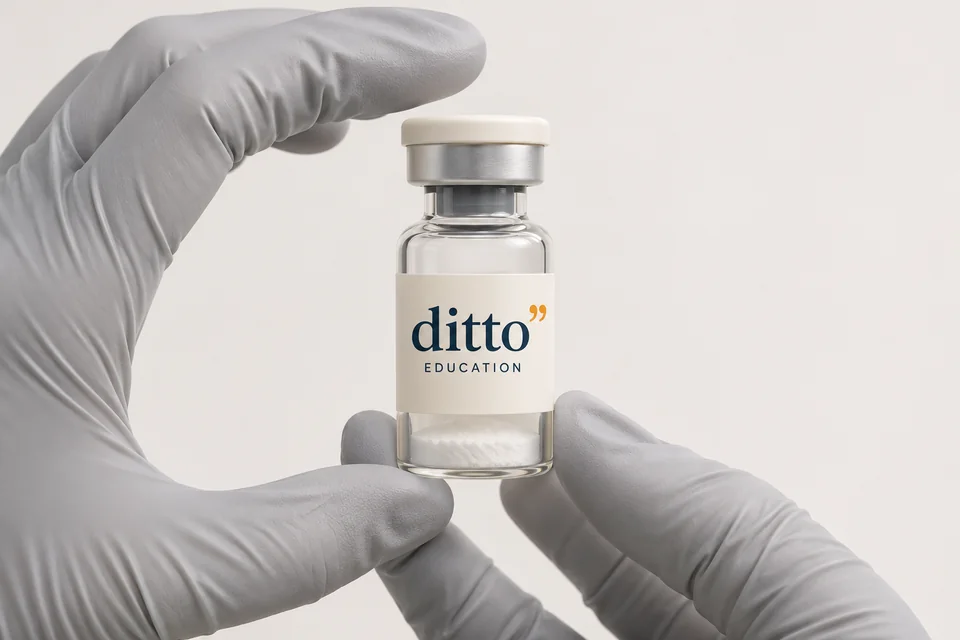
Check the exact product
Read the label, formulation, vial content, expiry and preparation instructions. Check the vial and closure for damage. Appearance alone cannot establish identity, purity or sterility.

Clean the stopper
If the product instructions call for vial access, disinfect the exposed rubber stopper with a fresh alcohol swab and let it dry. Avoid touching it afterward; use sterile equipment for each access.

Measure the specified diluent
Confirm the diluent type and volume in the product instructions. Measure that volume using the correct syringe scale. A concentration calculation cannot establish that a diluent is compatible.

Add as instructed
Follow the product-specific addition method. Where slow addition along the vial wall is specified, keep the flow gentle. Do not infer a preparation method from a dose table or combine separate compounds in one vial.

Mix and inspect
Use the mixing method specified for the product; some require gentle swirling rather than shaking. Compare the appearance with the instructions. Do not use a preparation with unexpected particles, discoloration or suspected contamination.

Record and store
Record the preparation date and calculated concentration in mg/mL and mcg/mL. Follow the exact storage conditions and discard time on the product instructions. There is no universal refrigerated shelf life for all peptides.
Record and store
Record the preparation date and calculated concentration in mg/mL and mcg/mL. Follow the exact storage conditions and discard time on the product instructions. There is no universal refrigerated shelf life for all peptides.
AI-generated educational scenes with Ditto-inspired concept labels; not photographs of supplied products. CDC preparation and equipment principles · Check your calculation
Helpful tool
For unit-conversion math across other vial sizes, use the University of Peptide calculator.
How DSIP Works
DSIP is a small naturally occurring nonapeptide with the amino acid sequence Trp-Ala-Gly-Gly-Asp-Ala-Ser-Gly-Glu and a molecular weight of about 849 daltons. Its name comes from the early observation that infusion produced delta-wave (slow-wave) EEG activity in rabbits.
Despite decades of work, the precise receptor and mechanism are still not fully established. Reviews describe possible interactions with NMDA receptors, alpha-adrenergic signaling, opioid receptors, and the hypothalamic-pituitary-adrenal axis. DSIP-like material has been found in the hypothalamus, limbic system, pituitary, and gut.
Older work characterized DSIP as a sleep-modulating peptide rather than a sedative, with a U-shaped activity curve where small doses or short infusions produced the strongest effect.
Who DSIP Is For and Who Should Avoid It
DSIP is a research-use compound. There is no FDA-approved indication, dose, or population. The points below are general boundaries that show up in the literature and in compounding-pharmacy review.
- Pregnancy and lactation: not studied; should be avoided.
- Children and adolescents: no human pediatric data.
- Untreated obstructive sleep apnea: any sleep-modulating compound deserves clinical oversight.
- Active substance dependence: published trials in opioid- and alcohol-withdrawal contexts were small and used clinical settings, not self-directed protocols.
- Adrenal or thyroid disease: DSIP can interact with HPA-axis signaling; clinical oversight is warranted.
- Anyone on sedating medications: combined effects are not well characterized.
DSIP Side Effects & Safety
Older human trials and reviews report that DSIP appeared well tolerated at the doses tested, with transient effects such as mild headache, nausea, and dizziness in some subjects. Long-term safety has not been formally established.
Reported and Theoretical Risks
- Mild transient headache or nausea reported in some early human studies.
- Possible morning sluggishness or vivid dream effects described in research write-ups.
- Theoretical immunogenicity flagged by FDA in the Category 2 listing.
- Possible interaction with HPA-axis hormones; not characterized in modern trials.
- Quality-control risk for any research-use peptide (purity, contamination, mislabeling).
Quality-control note
Because DSIP is research-use only, batch-level COA review and supplier verification matter. Read the archived review’s COA reading worksheet before ordering.
DSIP Timeline & What to Monitor
Older trials measured sleep architecture changes within the first or second night of dosing, using polysomnography. Subjective sleep-quality changes were sometimes reported on the first night and built up across short courses.
- Night 1-2: subjective sleep changes are most often reported here.
- Week 1: short-course trials measured sleep architecture and daytime alertness across 5-7 nights.
- Week 4: end of a typical research planning cycle and reasonable review point.
- Long-term: no reliable long-term outcome data exists.
Reasonable things to track during a research cycle include subjective sleep quality, time to fall asleep, number of awakenings, morning alertness, and any side effects. Treatment of an actual sleep disorder belongs with a clinician, not with a research-use peptide.
DSIP Clinical Evidence Context
Human evidence
A handful of small placebo-controlled studies in chronic insomniacs from 1981-1987 reported modest improvements in total sleep time, sleep efficiency, and daytime function. Other studies in the same era found that improvement did not reach clinically significant differences from placebo. Sample sizes were 6-14 subjects.
Withdrawal context
Russian and Eastern-European trials examined DSIP in opioid- and alcohol-withdrawal settings and reported reduced symptom severity in case-series and open-label work. These were not modern double-blind RCTs.
Preclinical evidence
DSIP has been studied in rabbits, rats, mice, and cats; it crosses the blood-CSF barrier; it has been tied to delta-wave EEG activity, neurotransmitter changes, motor recovery in rat stroke models, and HPA-axis signaling.
Evidence gap
There is no modern, large-sample, FDA-recognized RCT establishing DSIP's efficacy in any indication. The PCAC review scheduled for July 2026 is the next formal regulatory review point.
DSIP Storage & Handling
DSIP Storage
| State | Storage | Notes |
|---|---|---|
| Lyophilized (Powder Form) | -4F (-20C) long-term | Use supplier label and stability data; protect from light. |
| Reconstituted (Liquid Form) | 35.6-46.4F (2-8C) | Use within typical research peptide stability windows; refer to supplier guidance. |
Do not freeze reconstituted DSIP. Discard if cloudy, discolored, or past beyond-use date.
DSIP Protocol Mistakes & Troubleshooting
- Missed evening dose: most research write-ups simply skip and resume the next night rather than doubling up.
- Cloudy vial after reconstitution: do not use; contact the supplier and review the COA.
- Wrong BAC-water volume: recalculate concentration before drawing; do not guess. Use the University of Peptide calculator.
- Morning grogginess: most research write-ups describe shifting the dose earlier in the evening before lowering the dose itself.
- Site rotation and reconstitution/storage review are standard clinical guidance; persistent reactions warrant medical evaluation.
- Storage mistake: if reconstituted DSIP was left at room temperature, treat the vial as compromised.
DSIP Regulatory Status
As of June 2026, DSIP is not FDA-approved for any human indication. The FDA refers to DSIP in the Federal Register as Emideltide.
DSIP/Emideltide was placed on the FDA's Category 2 list of bulk drug substances that may not be compounded due to significant safety risks in September 2023. The FDA's Pharmacy Compounding Advisory Committee (PCAC) is scheduled to review Emideltide in July 2026 for proposed uses in opioid withdrawal, chronic insomnia, and narcolepsy.
Internationally, DSIP is not formally approved as a drug in the EU, UK, Canada, or Australia. WADA does not list DSIP by name on its prohibited substances list as of 2026.
Status check
Regulatory listings change. Verify the current Category 2 / Emideltide status on the FDA website before making any sourcing decisions.
DSIP vs Melatonin vs Epitalon vs Benzodiazepines
DSIP vs Common Sleep-Adjacent Compounds
| Compound | What it is | Mechanism (in plain English) | Regulatory status (US) |
|---|---|---|---|
| DSIP | Nonapeptide | Modulates sleep architecture; not a sedative. | Not FDA-approved · Category 2 (2023) · PCAC July 2026 |
| Melatonin | Hormone supplement | Shifts sleep timing via the circadian system. | OTC supplement |
| Epitalon | Tetrapeptide | Studied for circadian/longevity markers; sleep effects anecdotal. | Not FDA-approved · research-use |
| Benzodiazepines | Prescription drugs | GABA-A agonists; sedate but degrade sleep architecture. | FDA-approved prescription drugs |
These compounds work through different mechanisms and are not interchangeable.
DSIP Blood Tests & Monitoring
DSIP is usually discussed in sleep and stress-response research. Routine labs do not directly measure sleep-peptide response, so monitoring is mostly a broad health and medication-context screen.
Blood test markers to discuss with a clinician
| Marker | Why it matters | Timing |
|---|---|---|
| CBC with differential | Screens broad blood-cell patterns that may affect fatigue, infection context, or general health interpretation. | Baseline |
| Comprehensive metabolic panel (CMP) | Reviews liver, kidney, electrolyte, and glucose context before interpreting fatigue or sleep changes. | Baseline |
| TSH and free T4 | Thyroid imbalance can affect sleep, energy, and mood. | Optional |
| A1c | Glucose swings and metabolic stress can affect sleep quality and fatigue. | Optional |
Monitoring guidance is pathway-based because DSIP does not have established clinical lab-monitoring standards.
At-home blood test option
Easy at home option to monitor core metrics during research cycles.
Beyond Whoosh
Pharmacy Grade DSIP
Prescription-grade peptide care through Beyond Whoosh. Whoosh prescribes after a clinician reviews your eligibility.
Simple timing framework
- Baseline
- Discuss baseline review before starting, especially with sleep disorders, psychiatric history, sedating medications, liver disease, or kidney disease.
- Follow-up
- Re-check broad labs after 8-12 weeks if the protocol continues or symptoms change.
- Longer term
- For recurring sleep-focused protocols, review sleep quality, medication changes, and broad health markers periodically.
How to interpret the labs
- Routine labs do not prove whether DSIP is improving sleep architecture.
- Medication interactions, alcohol use, sleep apnea, anxiety, and depression can all affect sleep more than labs show.
- Sleep tracking and symptom logs may be more useful than repeated broad labs alone.
Do not wait for routine labs
Severe daytime sedation, confusion, breathing pauses during sleep, or worsening mood symptoms need clinical review. New suicidal thoughts or severe anxiety changes require urgent help.
FAQ
Q1: What is DSIP peptide?
DSIP, or delta sleep-inducing peptide, is a nine-amino-acid neuropeptide first isolated in 1974 from the cerebral venous blood of sleeping rabbits. It has been studied for sleep, opioid and alcohol withdrawal, stress, and pain modulation. The FDA refers to it as Emideltide.
Q2: Is DSIP FDA-approved?
No. DSIP is not FDA-approved for any human indication. As of September 2023 it is on the FDA Category 2 list of bulk drug substances that may not be compounded, and a PCAC review is scheduled for July 2026 under the name Emideltide.
Q3: What is a typical DSIP dose used in research?
Two patterns appear in the literature. Older human trials used 25 nmol/kg intravenously for short 4-7 night courses. Community research planning today is mostly subcutaneous in the 100-300 mcg (0.1-0.3 mg) range. This is not a dosing recommendation.
Q4: How is DSIP reconstituted?
A common research approach is to add 2.0 mL of bacteriostatic water to a 10 mg (10,000 mcg) vial, which gives a 5 mg/mL (5,000 mcg/mL) working concentration. On a U-100 insulin syringe, 0.02 mL (2 units) is about 100 mcg (0.1 mg), 0.04 mL (4 units) is about 200 mcg (0.2 mg), and 0.06 mL (6 units) is about 300 mcg (0.3 mg). For other vial sizes, use the University of Peptide calculator.
Q5: When is DSIP usually injected?
Most research write-ups describe a single evening subcutaneous research-use dose 1-3 hours before intended sleep. Older human studies used short intravenous courses given in clinical settings.
Q6: What are the reported side effects of DSIP?
Older trials and reviews report mild transient headache, nausea, and occasional dizziness. The FDA flagged theoretical immunogenicity risk in its Category 2 listing. Long-term safety has not been formally established.
Q7: How does DSIP compare to melatonin?
Melatonin is an OTC hormone supplement that mainly shifts sleep timing through the circadian system. DSIP is a research-use peptide that has been described as modulating sleep architecture (especially slow-wave sleep) rather than acting as a sedative. They work through different pathways and are not interchangeable.
Q8: Is DSIP medical advice?
No. This page is an educational research reference. DSIP is not FDA-approved and is currently on the FDA Category 2 do-not-compound list. Talk to a qualified clinician before any peptide use.
Sources & Research
- Graf MV, Kastin AJ. Delta-sleep-inducing peptide (DSIP): a review. Neuroscience and Biobehavioral Reviews (1984)
- Graf MV, Kastin AJ. Delta-sleep-inducing peptide (DSIP): an update. Peptides (1986)
- Kovalzon VM, Strekalova TV. Delta sleep-inducing peptide (DSIP): a still unresolved riddle. Journal of Neurochemistry (2006)
- Schneider-Helmert D, Schoenenberger GA. The influence of synthetic DSIP (delta-sleep-inducing-peptide) on disturbed human sleep. Experientia (1981)
- Schneider-Helmert D. Effects of delta-sleep-inducing peptide on 24-hour sleep-wake behaviour in severe chronic insomnia. European Neurology (1987)
- Salgado-Puga K, et al. Study of delta sleep-inducing peptide efficacy in improving sleep on short-term administration to chronic insomniacs. European Neurology (1987)
- Khvatova EM, et al. Delta sleep-inducing peptide recovers motor function in SD rats after focal stroke. Molecules (2021)
- Wang Z, et al. Pichia pastoris secreted peptides crossing the blood-brain barrier and DSIP fusion peptide efficacy in PCPA-induced insomnia mouse models. Frontiers in Pharmacology (2024)
- U.S. Food and Drug Administration. Certain bulk drug substances for use in compounding that may present significant safety risks (Category 2). FDA.gov (2023)
- Cox JR. Delta sleep-inducing peptide. European Journal of Anaesthesiology (2001)
Related Dosing Protocols
Reconstitution calculator
Enter your own values. This tool calculates quantities, not a recommended dose.
Check the concentration
Changing the unit keeps the entered mass equivalent. 1 milligram (mg) = 1,000 micrograms (mcg). This tool does not choose a target amount.
Biological IU (optional, product-specific)
Only enter a potency explicitly stated as IU per mg on the exact product label or reference. Do not enter the 100 from a U-100 syringe. No factor is assumed for any peptide.
Your result will appear here
Enter the mass, final solution volume and target mass, or load a fictional example.
Assumes accurate masses, final solution volume and even distribution. Blend arithmetic does not establish whether substances can be mixed. Read the formulas and assumptions.
Study findings, reported examples and supplier statements have different levels of evidence. Follow the citations and check the formulation, population and date before interpreting a number.
Editorial standards and corrections