On this page
TOOLS FOR THIS GUIDE
Work with LL-37
The guide name carries across. Amounts, dates and instructions remain yours to enter; opening a tool saves nothing.
Worked examples: calculations, records and source checks
Fictional arithmetic, unrelated to a recommended amount of LL-37: 10 mg (10,000 mcg) in a final 2 mL is 5 mg/mL (5,000 mcg/mL). A target mass of 0.25 mg (250 mcg) corresponds to 0.05 mL, or 5 U-100 syringe markings. Biological IU cannot be inferred from these inputs. Neither the mass nor the liquid is a preparation recommendation.
Open the arithmetic example- Supply example: two 10 mg (10,000 mcg) vials start at 20 mg (20,000 mcg). Four recorded entries of 0.25 mg (250 mcg) leave a theoretical 19 mg (19,000 mcg), before losses or expiry. Skipped entries do not deduct stock.
- Measurement example: enter “Sleep duration”, “7.5”, “hours” and the date. Keep the same unit and note changing conditions. A trend does not prove a treatment effect.
- Source example: record “rat study” when rats were studied, even when the headline describes recovery. Keep the exact paper and its limitations.
The planner accepts mg and mcg. Biological IU/USP units, sprays, drops and variable mixtures need product-specific instructions; they cannot be inferred from a generic mass calculator. For stacks, record each known ingredient separately.
FDA: why concentration and unit errors matterEvidence & source checks
LL-37: source check
A 34-participant trial of topical LL-37 in venous leg ulcers found healing signals at two lower tested concentrations but not the highest.
Limit: Topical wound findings cannot be transferred to systemic injection, infection treatment or general immune claims.
Question to resolve: Does the claimed use match topical wound treatment rather than a different route or condition?
Source and reading scope
Treatment with LL-37 is safe and effective in enhancing healing of hard-to-heal venous leg ulcers: a randomized, placebo-controlled clinical trial.
PubMed abstract; not an independent clinical review. Checked 25 November 2026.
What to verify before filling a plan
- Identity and formulation: match the name, sequence or active ingredient, route and strength. A related molecule or branded medicine is not automatically equivalent.
- Instruction source: obtain the actual amount, frequency and duration from qualified medical instructions. A community table or trial protocol does not establish an individual regimen.
- Units and product details: keep mass, liquid volume and biological activity units separate. Record batch, storage and discard instructions from the actual product; the tools cannot determine sterility or stability.
- Review and follow-up: list medicines and supplements, unresolved interactions and questions. Agree on relevant observations and actions with a qualified professional; normal measurements do not prove safety.
Selected source context, not a systematic review or medical approval. Study cards checked 24 November 2026; guide source notes checked 25 November 2026. Research references and citations appear below.
Guide summary
REFERENCE SUMMARY- Compound
- LL-37 (human cathelicidin, CAP-18 fragment)
- Class
- Antimicrobial / host-defense peptide
- Common format
- Lyophilized powder for subQ (trials used topical gel)
- Regulatory status
- Not FDA-approved; investigational as ropocamptide
LL-37 Quick Start
LL-37 is the only cathelicidin antimicrobial peptide made by humans. It comes from a larger protein called hCAP-18 and helps the body respond to microbes, inflammation, and wound repair. In the research-peptide market, it is usually sold as a freeze-dried powder that is reconstituted before subcutaneous injection.
There is an important gap to understand before planning anything. The human clinical trials for LL-37 delivered it as a gel applied directly onto a leg ulcer, not as an injection. The daily subcutaneous protocol common in the research community is community-derived, not trial-validated.
- What it is
- The only human cathelicidin; a 37-amino-acid host-defense peptide.
- Trial route
- Topical wound gel at 0.5-1.6 mg/mL (500-1,600 mcg/mL), twice weekly.
- Community route
- SubQ injection from a reconstituted vial (no human-trial support).
- Research status
- Not FDA-approved; investigational as ropocamptide.
Educational research reference only
This page summarizes how LL-37 is discussed and planned in research settings. It is not medical advice, a prescription, or a treatment plan. LL-37 is not FDA-approved for human use. Talk to a qualified clinician before using any peptide.
LL-37 Dosing Protocol & Schedule
LL-37 has two very different dosing contexts. The clinical-trial picture is topical and measured as a concentration on the wound. The research-community picture is a subcutaneous injection measured in micrograms. They are not interchangeable, so this section keeps them on separate tabs.
LL-37 Dosing Guide
Choose the format you are researching. The trial tab reports what studies actually tested; the community tab describes the informal injectable structure.
Open a format reference below.
Community subq format reference
Informal community structure for injectable research-use LL-37. This has not been tested in human trials.
Community write-ups commonly describe a low daily subcutaneous dose for a short block of weeks. Reported figures cluster around 100-250 mcg (0.1-0.25 mg) per day, with some advanced write-ups going up to 500 mcg (0.5 mg) per day. Frequency is usually once daily, often 5 days on with 2 days off, for a 2-4 week block.
Community-derived subQ structure (not trial-validated)
| Item | Commonly reported |
|---|---|
| Starting range | 100-200 mcg/day (0.1-0.2 mg/day) |
| Upper range cited | Up to 500 mcg/day (0.5 mg/day) |
| Frequency | Once daily, often 5 days/week |
| Cycle length | 2-4 weeks, then a break |
| Route | Subcutaneous injection |
These figures come from supplier and community sources, not clinical trials. Higher doses are linked in the literature to stronger inflammatory and mast-cell effects, so 'more' is not safer.
No human-trial support for injection
No published human trial has tested subcutaneous LL-37. The wound-healing results people cite come from a topical gel. Treat the subQ structure above as unverified community practice, not evidence.
Trial topical format reference
What the actual human studies delivered, for reference only.
In the published trials, LL-37 was mixed into a gel and applied to the ulcer surface twice a week. The tested concentrations were 0.5 and 1.6 mg/mL (500 and 1,600 mcg/mL) (an earlier first-in-man study also tested 3.2 mg/mL (3,200 mcg/mL)). Notably, the lowest concentration, 0.5 mg/mL (500 mcg/mL), produced the best healing rate.
Concentrations tested in human LL-37 wound trials
| Concentration | Schedule | Setting |
|---|---|---|
| 0.5 mg/mL (500 mcg/mL) | Twice weekly, topical | Best healing rate in both trials |
| 1.6 mg/mL (1,600 mcg/mL) | Twice weekly, topical | Effective but less than 0.5 mg/mL (500 mcg/mL) |
| 3.2 mg/mL (3,200 mcg/mL) | Twice weekly, topical | First-in-man only; not carried forward |
This is trial reporting, not a dosing recommendation. The gel was applied by trained staff during dressing changes in a controlled study.
Cycle Guidelines (community structure)
| Approach | Duration | Off Period | Context |
|---|---|---|---|
| Short block | 2-3 weeks | 2+ weeks | Most common community structure |
| Standard block | 4 weeks | 2-4 weeks | Upper end of typical write-ups |
Cycle framing is community-derived. There is no validated human cycle length for injected LL-37.
LL-37 Supplies Needed
Planning is based on the community subQ structure above: a 5 mg (5,000 mcg) vial reconstituted with 2 mL BAC water (2.5 mg/mL (2,500 mcg/mL)), drawing 250 mcg (0.25 mg) (10 units) per day, 5 days per week. Adjust if your vial size or dose differs. Because LL-37 degrades over time in solution, do not reconstitute more than you will use within its refrigerated window.
Recommended Supply
Choose your region
Use discount code SAVE10 at Peptira checkout. See why we love Peptira.
LL-37

At-Home Blood Test
Research Supplies
Peptide Vials
Based on a 5 mg (5,000 mcg) vial and a 250 mcg (0.25 mg) daily draw, one vial yields about 20 doses.
| Cycle length | Planning note |
|---|---|
2-4 weeks 1 vial | 2 weeks: 10 doses needed; 4 weeks: 20 doses needed |
6-8 weeks 2 vials | 6 weeks: 30 doses needed; 8 weeks: 40 doses needed |
Insulin Syringes (U-100)
Prefer 0.3 mL / 30-unit syringes; a 250 mcg (0.25 mg) draw is only 10 units at 2.5 mg/mL (2,500 mcg/mL).
| Cycle length | Planning note |
|---|---|
2 weeks 10 syringes | 1 per dose |
4 weeks 20 syringes | 1 per dose |
Bacteriostatic Water
Use 2 mL per 5 mg (5,000 mcg) vial for reconstitution.
| Cycle length | Planning note |
|---|---|
2-4 weeks 1 x 10 mL bottle | 1 vial uses 2 mL |
Round up for priming losses, dropped syringes, and degradation. LL-37 is prone to breaking down in solution, so plan smaller reconstitutions used sooner rather than one large batch.
Companion Supplies & Routine Support
LL-37 Reconstitution Guide
Reconstitution turns the dry powder into a measurable liquid. The key math is simple: vial size divided by BAC water gives the concentration, and dose divided by concentration gives the draw volume. On a U-100 syringe, 1 mL equals 100 units.
Example: a 5 mg (5,000 mcg) vial plus 2 mL of BAC water gives 2.5 mg/mL (2,500 mcg/mL). A 250 mcg (0.25 mg) dose is 0.10 mL, which is 10 units on a U-100 syringe. A 10 mg (10,000 mcg) vial plus 2 mL gives 5 mg/mL (5,000 mcg/mL), so 250 mcg (0.25 mg) becomes 0.05 mL, or 5 units.
Draw volume by dose at 2.5 mg/mL (2,500 mcg/mL) (5 mg (5,000 mcg) vial + 2 mL)
| Dose | Volume | U-100 units |
|---|---|---|
| 100 mcg (0.1 mg) | 0.04 mL | 4 units |
| 200 mcg (0.2 mg) | 0.08 mL | 8 units |
| 250 mcg (0.25 mg) | 0.10 mL | 10 units |
| 500 mcg (0.5 mg) | 0.20 mL | 20 units |
Units are for standard U-100 insulin syringes. If your vial is 10 mg (10,000 mcg), halve the volume and units for the same dose.
An illustrated reading aid for the product instructions. Confirm the exact formulation, diluent and handling method first. A research-only vial is not an approved medicine.

Clean the stopper
If the product instructions call for vial access, disinfect the exposed rubber stopper with a fresh alcohol swab and let it dry. Avoid touching it afterward; use sterile equipment for each access.

Measure the specified diluent
Confirm the diluent type and volume in the product instructions. Measure that volume using the correct syringe scale. A concentration calculation cannot establish that a diluent is compatible.

Add as instructed
Follow the product-specific addition method. Where slow addition along the vial wall is specified, keep the flow gentle. Do not infer a preparation method from a dose table or combine separate compounds in one vial.

Mix and inspect
Use the mixing method specified for the product; some require gentle swirling rather than shaking. Compare the appearance with the instructions. Do not use a preparation with unexpected particles, discoloration or suspected contamination.
Check the exact product
Read the label, formulation, vial content, expiry and preparation instructions. Check the vial and closure for damage. Appearance alone cannot establish identity, purity or sterility.

Record and store
Record the preparation date and calculated concentration in mg/mL and mcg/mL. Follow the exact storage conditions and discard time on the product instructions. There is no universal refrigerated shelf life for all peptides.
Record and store
Record the preparation date and calculated concentration in mg/mL and mcg/mL. Follow the exact storage conditions and discard time on the product instructions. There is no universal refrigerated shelf life for all peptides.
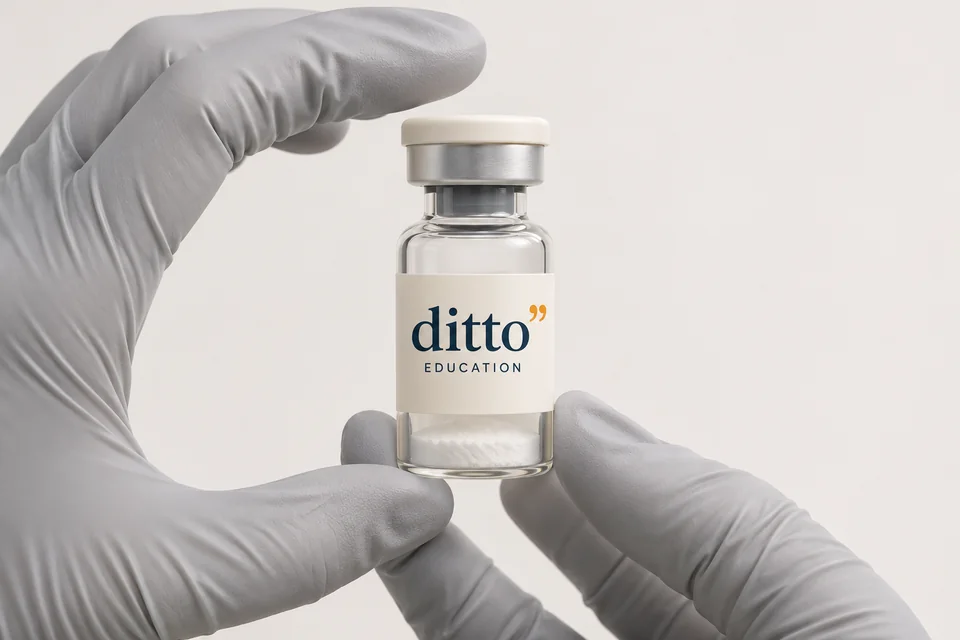
AI-generated educational scenes with Ditto-inspired concept labels; not photographs of supplied products. CDC preparation and equipment principles · Check your calculation
Calculator
Use a reconstitution calculator to match your exact vial size, BAC water volume, and target dose to milliliters and U-100 units.
LL-37 SubQ Dosage Chart
This chart summarizes the commonly reported subQ LL-37 ranges from the dosing section above.
 UNIVERSITY OF PEPTIDE · RESEARCH REFERENCE
LL-37 SubQ Dosage Chart
| Approach | Duration | Off Period | Context |
|---|---|---|---|
| Short block | 2-3 weeks | 2+ weeks | Most common community structure |
| Standard block | 4 weeks | 2-4 weeks | Upper end of typical write-ups |
How LL-37 Works
In plain terms, LL-37 does two jobs. First, it pokes holes in the outer membranes of bacteria, some fungi, and some viruses, which can kill them directly. Second, it acts as a signal that calls immune cells to a site and shapes how much inflammation happens there.
The peptide carries a strong positive charge and folds into an amphipathic alpha-helix, which lets it bind negatively charged microbial membranes and disrupt them. Beyond that, it binds bacterial endotoxin (LPS), acts through receptors such as FPR2 and scavenger receptors, recruits cells, blocks biofilm formation, and supports new blood vessels and skin regrowth in wounds.
- Direct antimicrobial action through membrane disruption.
- Immune signaling via FPR2, scavenger receptors, and LPS binding.
- Wound-repair support through angiogenesis and re-epithelialization.
- A double-edged side: LL-37 can also amplify inflammation and self-nucleic-acid immune responses.
That last point matters. The same signaling that helps wounds can, in the wrong context, push inflammation. LL-37 complexed with self-DNA or self-RNA is a documented driver of immune activation in psoriasis and lupus, which is why LL-37 is not simply a 'clean' immune booster.
Who Should Be Cautious With LL-37
Because LL-37 can amplify inflammation, the literature points to a few groups that may need extra caution. This is educational context, not a medical screening tool.
- People with autoimmune or autoinflammatory conditions such as psoriasis, lupus (SLE), or rosacea, where LL-37 is implicated in disease activity.
- Anyone who is pregnant or breastfeeding — there is no safety data.
- People on medications that affect the immune system, without clinician oversight.
- Anyone with a history of strong reactions to injected peptides.
Talk to a clinician
LL-37 is not FDA-approved and has no established safety profile for injection. These cautions are drawn from mechanism and disease-association research, not from a safety label.
LL-37 Side Effects & Safety
In the topical wound trials, LL-37 was well tolerated and the studies reported it as safe when applied locally with compression therapy. That safety finding is for the gel on skin, not for daily injection.
Community and clinic reports of subcutaneous use most often describe local injection-site reactions: redness, swelling, itching, or a burning sensation. This is consistent with LL-37's biology, since it can trigger mast cells to release histamine, which produces warmth, redness, and itching near the injection site.
- Injection-site redness, swelling, burning, or itching (most common reported).
- Histamine-type flushing or warmth from mast-cell activation.
- Theoretical risk of pushing inflammation in people prone to autoimmune skin disease.
- No large human safety database exists for injected LL-37.
Slower injection and a lower starting amount are commonly suggested to reduce local reactions. Persistent or spreading reactions are a stop signal.
LL-37 Expected Timeline & Monitoring
The only human timeline data comes from the wound trials. There, twice-weekly topical LL-37 improved healing rates over a 4-week (first-in-man) and 13-week (Phase IIb) treatment window, with the strongest effect in large, long-standing ulcers.
For injectable community use, there is no validated timeline because it has not been studied in human trials. Any promised week-by-week result should be treated as unsupported. For research planning, the practical focus is monitoring the injection site, tracking skin or inflammatory changes, and stopping if reactions build.
LL-37 Clinical Evidence Context
Human evidence for LL-37 is real but narrow. Two randomized, placebo-controlled trials tested a topical LL-37 gel on hard-to-heal venous leg ulcers, both run by the developer Promore Pharma under the drug name ropocamptide.
Human LL-37 wound trials
| Study | Design | Key result |
|---|---|---|
| First-in-man (2014) | 34 patients, topical 0.5/1.6/3.2 mg/mL vs placebo, twice weekly | Healing rate ~6x placebo at 0.5 mg/mL (500 mcg/mL); lowest dose worked best |
| HEAL LL-37, Phase IIb (2021) | 148 patients, topical 0.5/1.6 mg/mL vs placebo, 13 weeks | Safe and well tolerated; low dose improved healing of large ulcers |
Both trials were topical. Neither tested injection or any systemic use.
Everything else is preclinical or mechanistic: antimicrobial action, anti-biofilm activity, immune signaling, and disease-association work in psoriasis, lupus, and rosacea. Popular research-community claims about systemic infection control, gut health, or Lyme disease do not have human-trial support for injected LL-37.
The evidence boundary
Human proof exists for a topical wound gel at low concentration. It does not carry over to daily subcutaneous injection for immune or antimicrobial goals.
LL-37 Storage & Handling
LL-37 storage
Lyophilized powder
LL-37
-4°F (-20°C), long-term
Reconstituted liquid
LL-37
35.6-46.4°F (2-8°C), use promptly
Appearance
LL-37
Clear, colorless when mixed
| LL-37 | |
|---|---|
| Lyophilized powder | -4°F (-20°C), long-term |
| Reconstituted liquid | 35.6-46.4°F (2-8°C), use promptly |
| Appearance | Clear, colorless when mixed |
LL-37 is susceptible to proteolytic degradation in solution, so reconstituted vials should be kept cold, out of light, and used within a short window rather than stored for weeks.
LL-37 Troubleshooting
- Cloudy or particle-filled solution: discard it; do not use a solution that is not clear.
- Strong injection-site burning: this fits LL-37's mast-cell activity; slower injection and a lower amount are commonly suggested, and persistent reactions are a stop signal.
- Draw looks too large: use a smaller BAC-water volume for a more concentrated vial.
- Route confusion: the wound-healing evidence is topical, so injecting will not reproduce those trial results.
LL-37 Regulatory Status
As of July 2026, LL-37 is not FDA-approved for any indication. The synthetic drug version, ropocamptide, developed by Promore Pharma in Sweden, completed a Phase IIb topical wound-healing trial and is described by the company as being prepared for a future Phase III program. It has not received marketing authorization.
The LL-37 sold as a research peptide is a research-use-only product, not an approved medicine. It is not the same formulation as the topical drug candidate studied in trials.
LL-37 vs Nearby Peptides
In research-community discussion, LL-37 is often grouped with recovery and immune peptides, but its profile is distinct. BPC-157 and TB-500 are discussed for soft-tissue recovery and are not antimicrobial. KPV is discussed as an anti-inflammatory fragment. LL-37 is unusual because it is a direct antimicrobial and immune-signaling peptide with a genuine double edge: it can both fight microbes and amplify inflammation.
Where LL-37 sits
| Peptide | Main research framing | Antimicrobial? |
|---|---|---|
| LL-37 | Host defense, wound healing, immune signaling | Yes |
| BPC-157 | Soft-tissue recovery interest | No |
| TB-500 | Recovery and tissue repair interest | No |
| KPV | Anti-inflammatory fragment interest | No |
These compounds are not interchangeable and are studied for different reasons.
FAQ
Q1: What is LL-37 peptide?
LL-37 is the only cathelicidin antimicrobial peptide made by the human body. It is a 37-amino-acid host-defense peptide cut from a precursor protein called hCAP-18. It kills microbes by disrupting their membranes and also acts as an immune signal.
Q2: What is LL-37 used for in research?
It is studied for wound healing, antimicrobial and anti-biofilm activity, and immune signaling. The strongest human evidence is for topical wound healing in venous leg ulcers. Systemic immune or infection claims for injected LL-37 do not have human-trial support.
Q3: How is LL-37 dosed?
There is no validated human injection dose. Community write-ups describe roughly 100-250 mcg (0.1-0.25 mg) per day subcutaneously, up to 500 mcg (0.5 mg) in advanced protocols, for 2-4 weeks. The human trials used a topical gel at 0.5-1.6 mg/mL (500-1,600 mcg/mL) twice weekly, which is a different route entirely. See the dosing section for the side-by-side subQ and topical context.
Q4: How do you reconstitute LL-37?
A common setup is a 5 mg (5,000 mcg) vial plus 2 mL of bacteriostatic water, which gives 2.5 mg/mL (2,500 mcg/mL). At that strength a 250 mcg (0.25 mg) dose is 0.10 mL, or 10 units on a U-100 syringe. Keep the mixed vial refrigerated and use it promptly because LL-37 degrades in solution.
Q5: What are the side effects of LL-37?
Reported effects are mostly local: injection-site redness, swelling, itching, or burning. LL-37 can activate mast cells and release histamine, which explains the warmth and itch. In people prone to autoimmune skin disease, there is a theoretical risk of increased inflammation.
Q6: Is LL-37 FDA-approved?
No. As of July 2026 LL-37 is not FDA-approved for any use. The topical drug version, ropocamptide from Promore Pharma, finished Phase IIb and is being prepared for Phase III, but it has not been approved or marketed.
Q7: Does injecting LL-37 give the wound-healing results from the studies?
There is no evidence that it does. Every human LL-37 trial applied a gel directly to a wound, not an injection. The healing results belong to that topical, low-concentration setup and should not be assumed to transfer to subcutaneous injection.
Q8: Can LL-37 be used for Lyme disease or chronic infections?
There is no human-trial evidence for LL-37 in Lyme disease or systemic infection. Its antimicrobial action is documented in lab and preclinical settings only. Claims about clearing chronic infection in people are not supported.
Q9: Who should be cautious with LL-37?
People with autoimmune or autoinflammatory conditions such as psoriasis, lupus, or rosacea appear in the literature as higher-risk because LL-37 is tied to those disease processes. Anyone pregnant, breastfeeding, or on immune-affecting medication should not use it without clinician oversight.
Q10: Is this page medical advice?
No. This is an educational research reference. LL-37 is not an approved medicine, and nothing here is a prescription or treatment plan. Talk to a qualified clinician before using any peptide.
Sources & Research
- Gronberg A, Mahlapuu M, Stahle M, Whately-Smith C, Rollman O Treatment with LL-37 is safe and effective in enhancing healing of hard-to-heal venous leg ulcers: a randomized, placebo-controlled clinical trial. Wound Repair and Regeneration (2014)
- Mahlapuu M, Bjork J, Ekblom J, et al. Evaluation of LL-37 in healing of hard-to-heal venous leg ulcers: A multicentric prospective randomized placebo-controlled clinical trial (HEAL LL-37). Wound Repair and Regeneration (Phase IIb) (2021)
- Promore Pharma AB Ropocamptide (LL-37) — healing of chronic wounds, development status. Promore Pharma (developer/regulatory status) (2025)
- Bandurska K, Berdowska A, Barczynska-Felusiak R, Krupa P LL-37: Cathelicidin-related antimicrobial peptide with pleiotropic activity. BioFactors (review) (2015)
- Bhattacharjya S, Zhang Z, Ramamoorthy A LL-37: Structures, Antimicrobial Activity, and Influence on Amyloid-Related Diseases. Biomolecules (review) (2024)
- Amagai R, Takahashi T, Terui H, et al. The Antimicrobial Peptide Cathelicidin Exerts Immunomodulatory Effects via Scavenger Receptors. International Journal of Molecular Sciences (2023)
- Neshani A, et al. Antimicrobial peptides of the cathelicidin family: focus on LL-37 and its modifications. International Journal of Molecular Sciences (review) (2025)
- Kahlenberg JM, Kaplan MJ (context); review authors Cathelicidin LL-37: A new important molecule in the pathophysiology of systemic lupus erythematosus. Journal of Translational Autoimmunity (review) (2020)
- Niyonsaba F, Someya A, Hirata M, Ogawa H, Nagaoka I Evaluation of the effects of peptide antibiotics human beta-defensins and LL-37 on histamine release and prostaglandin D2 production from mast cells. European Journal of Immunology (2001)
- Nagaoka I, et al. Antimicrobial cathelicidin peptide LL-37 inhibits LPS/ATP-induced pyroptosis of macrophages by dual mechanism. PLoS ONE / PMC (2014)
- Zhang X, et al. Decoding LL-37: Structure and antimicrobial mechanisms against microbial threats. ScienceDirect (review) (2025)
Related Dosing Protocols
Educational use only
This guide is an educational research reference, not medical advice or a treatment plan. LL-37 is not FDA-approved for human use.
Calculate vial math
Use the calculator for custom vial size, BAC-water volume, and syringe-unit math.
Reconstitution calculator
Enter your own values. This tool calculates quantities, not a recommended dose.
Check the concentration
Changing the unit keeps the entered mass equivalent. 1 milligram (mg) = 1,000 micrograms (mcg). This tool does not choose a target amount.
Biological IU (optional, product-specific)
Only enter a potency explicitly stated as IU per mg on the exact product label or reference. Do not enter the 100 from a U-100 syringe. No factor is assumed for any peptide.
Your result will appear here
Enter the mass, final solution volume and target mass, or load a fictional example.
Assumes accurate masses, final solution volume and even distribution. Blend arithmetic does not establish whether substances can be mixed. Read the formulas and assumptions.
Study findings, reported examples and supplier statements have different levels of evidence. Follow the citations and check the formulation, population and date before interpreting a number.
Editorial standards and corrections