On this page
TOOLS FOR THIS GUIDE
Work with VIP
The guide name carries across. Amounts, dates and instructions remain yours to enter; opening a tool saves nothing.
Worked examples: calculations, records and source checks
Fictional arithmetic, unrelated to a recommended amount of VIP: 10 mg (10,000 mcg) in a final 2 mL is 5 mg/mL (5,000 mcg/mL). A target mass of 0.25 mg (250 mcg) corresponds to 0.05 mL, or 5 U-100 syringe markings. Biological IU cannot be inferred from these inputs. Neither the mass nor the liquid is a preparation recommendation.
Open the arithmetic example- Supply example: two 10 mg (10,000 mcg) vials start at 20 mg (20,000 mcg). Four recorded entries of 0.25 mg (250 mcg) leave a theoretical 19 mg (19,000 mcg), before losses or expiry. Skipped entries do not deduct stock.
- Measurement example: enter “Sleep duration”, “7.5”, “hours” and the date. Keep the same unit and note changing conditions. A trend does not prove a treatment effect.
- Source example: record “rat study” when rats were studied, even when the headline describes recovery. Keep the exact paper and its limitations.
The planner accepts mg and mcg. Biological IU/USP units, sprays, drops and variable mixtures need product-specific instructions; they cannot be inferred from a generic mass calculator. For stacks, record each known ingredient separately.
FDA: why concentration and unit errors matterEvidence & source checks
VIP: source check
The TESICO aviptadil comparison did not significantly improve 90-day clinical outcomes in COVID-19 respiratory failure and stopped for futility.
Limit: This supervised intravenous study does not validate nasal VIP or unrelated chronic-symptom protocols.
Question to resolve: Does the route and diagnosis match the evidence, and was the primary endpoint positive?
Source and reading scope
Intravenous aviptadil and remdesivir for treatment of COVID-19-associated hypoxaemic respiratory failure in the USA (TESICO): a randomised, placebo-controlled trial.
PubMed abstract; not an independent clinical review. Checked 25 November 2026.
What to verify before filling a plan
- Identity and formulation: match the name, sequence or active ingredient, route and strength. A related molecule or branded medicine is not automatically equivalent.
- Instruction source: obtain the actual amount, frequency and duration from qualified medical instructions. A community table or trial protocol does not establish an individual regimen.
- Units and product details: keep mass, liquid volume and biological activity units separate. Record batch, storage and discard instructions from the actual product; the tools cannot determine sterility or stability.
- Review and follow-up: list medicines and supplements, unresolved interactions and questions. Agree on relevant observations and actions with a qualified professional; normal measurements do not prove safety.
Selected source context, not a systematic review or medical approval. Study cards checked 24 November 2026; guide source notes checked 25 November 2026. Research references and citations appear below.
Guide summary
REFERENCE SUMMARY- Compound
- Vasoactive intestinal peptide (VIP)
- Class
- 28-aa neuropeptide, secretin/glucagon family
- Common format
- Intranasal spray or subcutaneous
- Regulatory status
- Not FDA-approved (503A Cat. 1)
VIP Peptide Quick Start
VIP stands for vasoactive intestinal peptide. It is a natural signaling molecule (a neuropeptide) made of 28 amino acids. The body makes it in the gut, brain, lungs, and other tissues, where it relaxes smooth muscle, widens blood vessels, and helps calm inflammation. It was first isolated from pig intestine in 1970, which is where the name comes from.
VIP shows up in four different product contexts, and they should not be treated as the same thing: compounded nasal spray, SubQ research vials, aviptadil, and Invicorp. This page focuses on the nasal and subcutaneous research formats and explains the others for context.
- Common formats
- Compounded intranasal spray (about 50 mcg (0.05 mg) per spray) or a subcutaneous research vial (often 10 mg (10,000 mcg)).
- Safety gate
- Lipase, a pancreas blood marker, is checked before and during use. Rising lipase or belly pain means stop.
- Reconstitution
- A 10 mg (10,000 mcg) subcutaneous vial with 3 mL bacteriostatic water gives about 3.33 mg/mL (3,330 mcg/mL).
- Research status
- Not FDA-approved as a standalone drug. Discuss any use with a qualified clinician.
Educational use only
This is an educational research reference, not medical advice. VIP is not FDA-approved as a standalone drug, and both injectable and intranasal use should be discussed with a qualified clinician before any use.
VIP Peptide Dosing Protocol & Schedule
VIP dosing changes by route. The SubQ table below covers the research-vial format; the intranasal tab covers clinic-style nasal spray protocols. Do not convert one route directly into the other.
VIP Dosing Guide by Route
Start here for SubQ research-vial dosing. The intranasal tab is included only for nasal-spray context.
Open a format reference below.
Subcutaneous format reference
The research-vial format behind most subcutaneous VIP protocols.
These ranges reflect commonly discussed SubQ VIP research protocols. They are not FDA-approved dosing instructions.
VIP (Vasoactive Intestinal Peptide) Research Dosing Protocol
| Phase | Dose | Frequency | Route | Duration |
|---|---|---|---|---|
| Conservative Start | 50 mcg (0.05 mg) | Once daily | SubQ | 1-2 weeks |
| Standard Research Dose | 100 mcg (0.1 mg) | 1-2x daily | SubQ | Ongoing |
| Advanced Research Dose | 200 mcg (0.2 mg) | 1-2x daily | SubQ | Ongoing |
| Clinic-Style Protocol | 200 mcg (0.2 mg) | 5x weekly | SubQ | Ongoing |
VIP Cycling Guidance
| Parameter | Recommendation |
|---|---|
| Loading Phase | Not typically used |
| Cycling | No standardized cycling protocol |
| Common Approach | Continuous administration |
| Maintenance | Lowest effective dose after response |
| Washout Period | Not established in literature |
- Community-reported dosing most commonly falls between 50-200 mcg (0.05-0.2 mg) per injection.
- 100 mcg (0.1 mg) twice daily is one of the most frequently discussed research protocols.
- VIP has a very short biological half-life, which is why divided daily dosing is common.
- There is currently no established FDA-approved subcutaneous VIP dosing protocol.
- Researchers commonly adjust frequency based on response rather than following fixed 8-12 week cycles.
This is not a dosing recommendation
Do not treat SubQ VIP like a casual supplement. At minimum, lipase should be checked before and during use, and a clinician should be involved.
Intranasal format reference
The clinic/CIRS nasal-spray format. Dispensed pre-compounded; no home reconstitution.
In the published clinic protocol associated with mold-illness (CIRS) work, the reported structure is 50 mcg (0.05 mg) per spray, often 4 to 8 sprays per day in alternating nostrils. Some severe cases reported higher daily totals under stricter monitoring. This is not a dosing recommendation.
A key detail from that protocol: the first dose is given in a clinic, with lipase and other labs checked before and shortly after, to watch for a pancreatic reaction. Use is meant to start only after other steps (such as removing mold exposure) are handled. The nasal spray is dispensed already prepared by a compounding pharmacy, so there is no home mixing.
This is not a dosing recommendation
The intranasal figures describe a clinician-supervised protocol with mandatory lab monitoring. Do not self-start intranasal VIP. Lipase must be checked, because pancreatitis is the main documented risk.
VIP Peptide Supplies Needed
The supply math below uses the high-end SubQ example from the dosing table: 200 mcg (0.2 mg), five days per week, from a 10 mg (10,000 mcg) vial mixed with 3 mL BAC water. At that concentration, one vial provides about 50 high-end doses. Lower 50-100 mcg (0.05-0.1 mg) doses last longer. Intranasal VIP is compounded by a pharmacy and does not use these supplies.
Recommended Supply
Choose your region
Use discount code PEPPAL at Peptide Partners checkout. See why we love Peptide Partners.
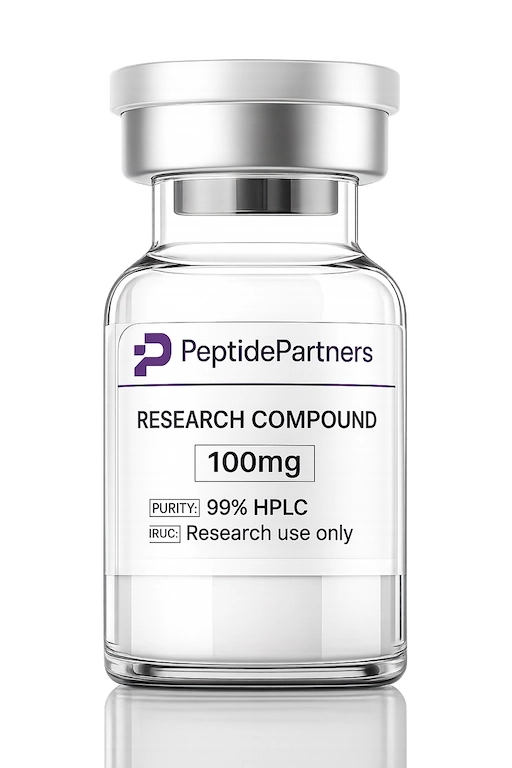
VIP (10mg (10,000 mcg) vials)

At-Home Blood Test
Research Supplies
Peptide Vials
Each 10 mg (10,000 mcg) vial reconstituted with 3 mL BAC water provides about 50 doses of 200 mcg (0.2 mg), 100 doses of 100 mcg (0.1 mg), or 200 doses of 50 mcg (0.05 mg).
| Cycle length | Planning note |
|---|---|
4-8 weeks 1 vial | 4 weeks: 20 high-end doses needed; one vial covers ~50.; 6 weeks: 30 high-end doses needed.; 8 weeks: 40 high-end doses needed. |
12 weeks 2 vials | 60 high-end doses needed; one vial covers ~50. |
Insulin Syringes (U-100)
One syringe per injection; 0.3 mL / 30-unit barrels suit 1.5-6 unit draws.
| Cycle length | Planning note |
|---|---|
4 weeks 20 syringes | 5 per week |
6 weeks 30 syringes | 5 per week |
8 weeks 40 syringes | 5 per week |
12 weeks 60 syringes | 5 per week |
Bacteriostatic Water
Use 3 mL per 10 mg (10,000 mcg) vial for reconstitution.
| Cycle length | Planning note |
|---|---|
4-12 weeks 1 x 10 mL bottle | 4 weeks: 1 vial uses 3 mL; 6 weeks: 1 vial uses 3 mL; 8 weeks: 1 vial uses 3 mL; 12 weeks: 2 vials use 6 mL |
Round up for priming losses, dropped syringes, and damaged swabs. Intranasal VIP is dispensed pre-compounded and does not use these reconstitution supplies.
Companion Supplies & Routine Support
VIP Peptide Reconstitution Guide
Reconstitution applies to the subcutaneous research vial, not the nasal spray (which arrives already prepared). The example below uses a 10 mg (10,000 mcg) lyophilized vial mixed with 3 mL bacteriostatic water.
Reconstitution Math (10 mg (10,000 mcg) vial, 3 mL BAC water)
| BAC water added | Concentration | 50 mcg (0.05 mg) | 100 mcg (0.1 mg) | 200 mcg (0.2 mg) |
|---|---|---|---|---|
| 3.0 mL | 3.33 mg/mL (3,330 mcg/mL) | 0.015 mL / 1.5 units | 0.030 mL / 3 units | 0.060 mL / 6 units |
This example assumes the vial holds 3 mL of BAC water. Very small draws can be harder to measure accurately, so use consistent concentration and syringe-unit math.
An illustrated reading aid for the product instructions. Confirm the exact formulation, diluent and handling method first. A research-only vial is not an approved medicine.
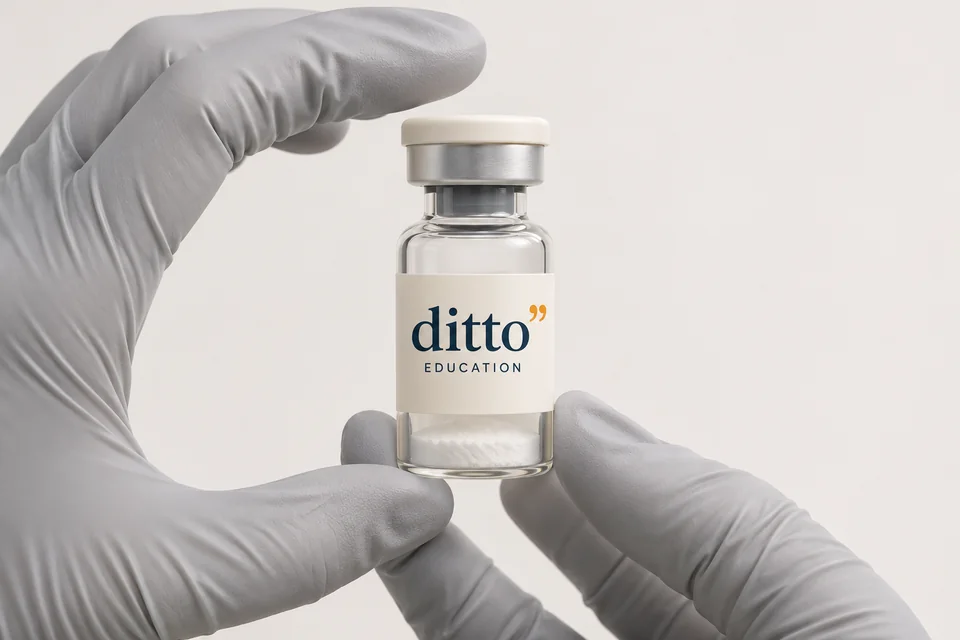
Check preparation conditions
Check the product instructions for the required preparation temperature. Do not warm a vial or change storage conditions based on a generic peptide guide.
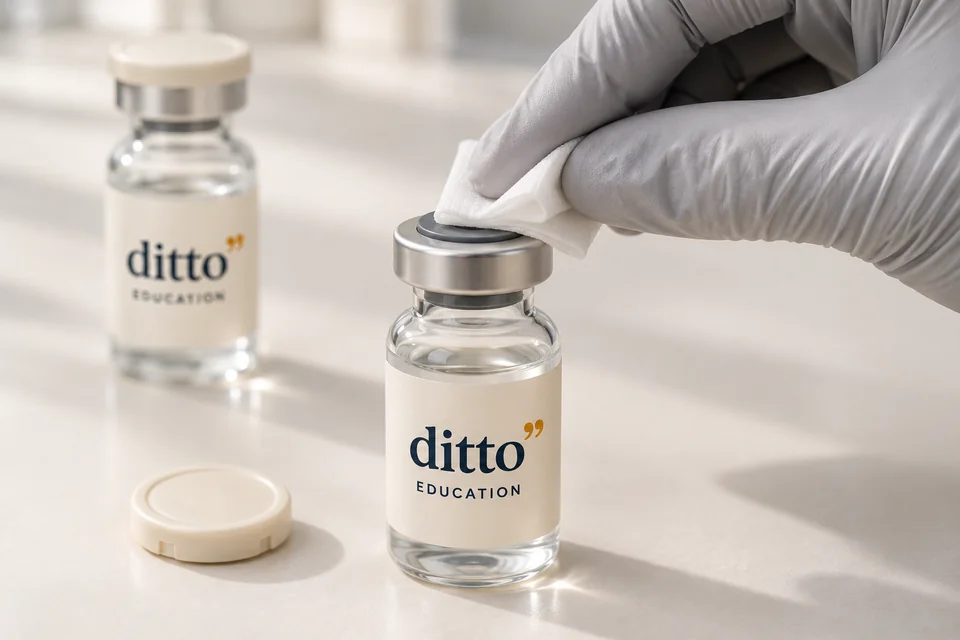
Clean the stopper
If the product instructions call for vial access, disinfect the exposed rubber stopper with a fresh alcohol swab and let it dry. Avoid touching it afterward; use sterile equipment for each access.
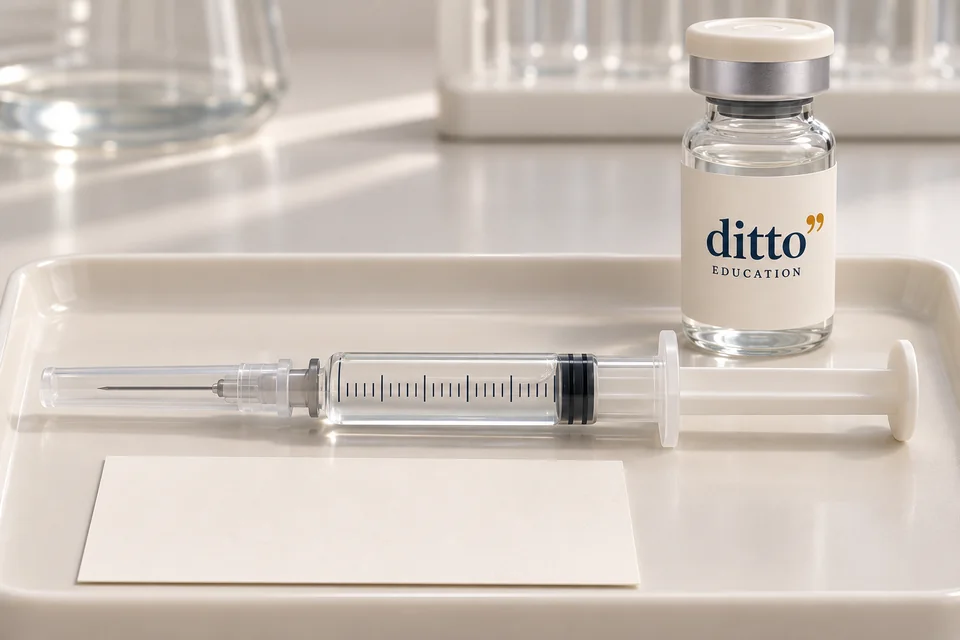
Measure the specified diluent
Confirm the diluent type and volume in the product instructions. Measure that volume using the correct syringe scale. A concentration calculation cannot establish that a diluent is compatible.
Check the exact product
Read the label, formulation, vial content, expiry and preparation instructions. Check the vial and closure for damage. Appearance alone cannot establish identity, purity or sterility.
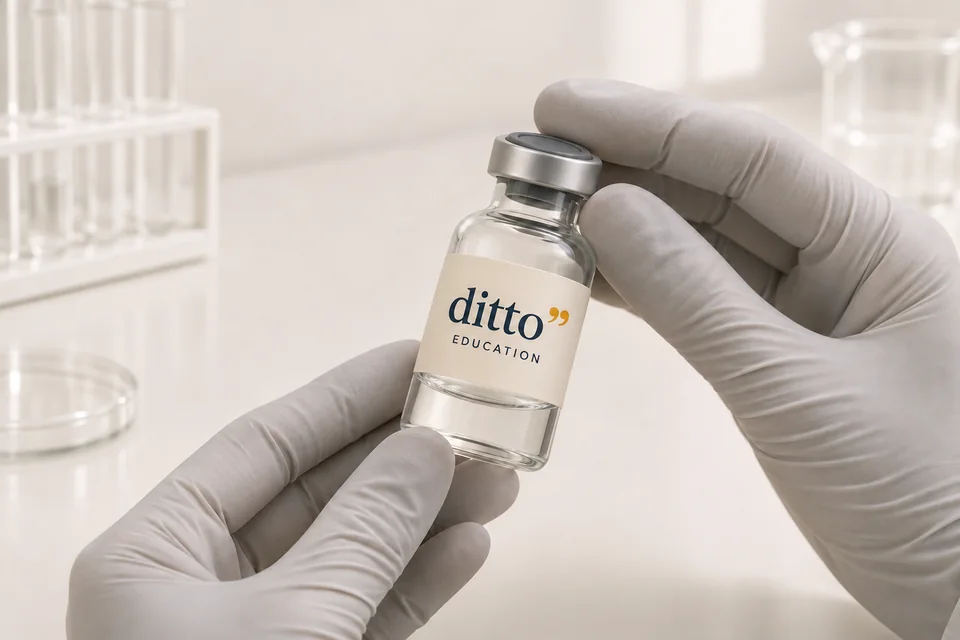
Mix and inspect
Use the mixing method specified for the product; some require gentle swirling rather than shaking. Compare the appearance with the instructions. Do not use a preparation with unexpected particles, discoloration or suspected contamination.
Mix and inspect
Use the mixing method specified for the product; some require gentle swirling rather than shaking. Compare the appearance with the instructions. Do not use a preparation with unexpected particles, discoloration or suspected contamination.
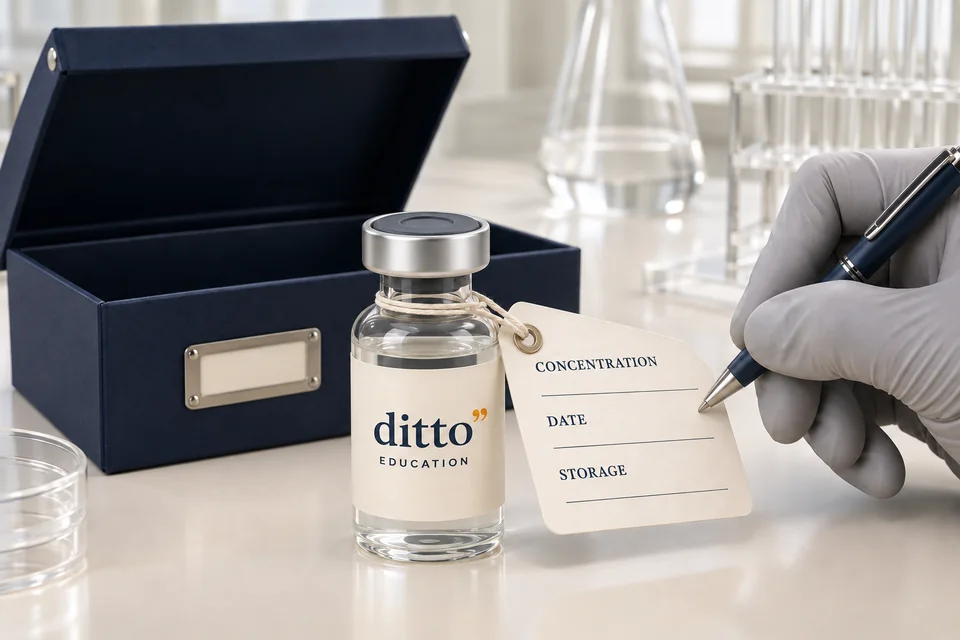
Record and store
Record the preparation date and calculated concentration in mg/mL and mcg/mL. Follow the exact storage conditions and discard time on the product instructions. There is no universal refrigerated shelf life for all peptides.
AI-generated educational scenes with Ditto-inspired concept labels; not photographs of supplied products. CDC preparation and equipment principles · Check your calculation
Check your numbers
Use the calculator for custom vial size, water volume, and syringe-unit math before drawing a dose.
VIP Dosage Chart
This VIP dosage chart summarizes the SubQ research dosing range from 50 mcg (0.05 mg) to 200 mcg (0.2 mg), with the common dosing phases shown by dose, frequency, route, and duration.
 UNIVERSITY OF PEPTIDE · RESEARCH REFERENCE
VIP Dosage Chart
| Phase | Dose | Frequency | Route | Duration |
|---|---|---|---|---|
| Conservative Start | 50 mcg (0.05 mg) | Once daily | SubQ | 1-2 weeks |
| Standard Research Dose | 100 mcg (0.1 mg) | 1-2x daily | SubQ | Ongoing |
| Advanced Research Dose | 200 mcg (0.2 mg) | 1-2x daily | SubQ | Ongoing |
| Clinic-Style Protocol | 200 mcg (0.2 mg) | 5x weekly | SubQ | Ongoing |
How VIP Works
In plain terms, VIP tells blood vessels and smooth muscle to relax and tells parts of the immune system to calm down. That is why it widens airways and blood vessels and lowers some inflammatory signals.
Technically, VIP binds two receptors called VPAC1 and VPAC2. These are G-protein-coupled receptors that raise cyclic AMP inside cells, which drives the muscle-relaxing and anti-inflammatory effects. VIP also acts in the brain's master clock (the suprachiasmatic nucleus), which links it to circadian timing.
- Targets: VPAC1 and VPAC2 receptors (cAMP signaling).
- Reported actions: vasodilation, smooth-muscle relaxation, immune modulation.
- Main limitation: human outcome evidence is thin for most marketed uses.
Who Should Avoid VIP
Some groups should not use VIP without close medical guidance. Because VIP can affect the pancreas, anyone with a history of pancreatitis or rising lipase should avoid it or stop.
- People with pancreatitis history or elevated lipase.
- Pregnant or breastfeeding people (safety not established).
- People with active cancer should discuss first; VIP receptors are overexpressed on some tumors, which is a theoretical concern.
- People with low blood pressure, because VIP can lower it further.
This list is not complete. A qualified clinician should review your full history and medications before any peptide use.
VIP Peptide Side Effects & Safety
The most reported short-term effects are flushing, mild headache, dizziness or lightheadedness (from blood-vessel widening and lower blood pressure), and loose stools. In the IV aviptadil trials, diarrhea and low blood pressure were the known side effects and were manageable in a hospital setting.
The effect that matters most for safety monitoring is the pancreas. Rising lipase or new belly pain is the documented reason to stop VIP. That is why protocols built around VIP check lipase before starting and during use.
Pancreas monitoring
Lipase is a blood marker for the pancreas. If lipase rises above the normal range or you develop abdominal pain, the standard guidance is to stop VIP and seek medical care.
VIP Expected Timeline & Monitoring
Be skeptical of the week-by-week 'benefit timelines' on supplier sheets. Those are marketing summaries, not trial endpoints, and they list far more conditions than the evidence supports.
Where VIP has been studied under supervision, monitoring matters more than a fixed timeline. In the clinic CIRS protocol, lipase is rechecked after the first dose, about two weeks in, and after any increase, with longer-term tracking of symptoms and labs. For most marketed VIP uses, there is still no strong trial evidence showing a predictable benefit timeline.
VIP Clinical Evidence Context
The evidence splits sharply by use. There is strong basic science on what VIP does in the body, but weak human-outcome data for most things it is sold for.
COVID / lung failure (aviptadil) — negative
The definitive NIH trial (ACTIV-3b / TESICO) found that IV aviptadil did NOT significantly improve outcomes through day 90 versus placebo. The FDA declined an emergency use authorization. This matters because many VIP summaries still discuss COVID use even though the largest trial was negative.
Erectile dysfunction (Invicorp) — approved in Europe
A penile-injection combination of aviptadil (VIP) 25 mcg (0.025 mg) plus phentolamine is licensed in some European countries as a second- or third-line ED option. Retrospective series report it can work and may hurt less than alprostadil. It is not FDA-approved in the US.
Mold illness / CIRS (nasal spray) — weak, open-label only
The popular CIRS use rests on small open-label and transcriptomic studies (around 15 to 20 patients) from one research group, plus large uncontrolled clinical experience. There is no placebo-controlled RCT, so this remains low-certainty evidence.
Lung conditions (sarcoid, pulmonary hypertension) — early
Inhaled VIP has been explored in small studies for sarcoidosis and pulmonary hypertension, with early signals but no approval.
Bottom line: VIP has real biology, but most claimed uses have not been proven in well-controlled human trials.
VIP Peptide Storage & Handling
Storage
Lyophilized (Powder Form)
VIP
-4F (-20C) long-term
Reconstituted (Liquid Form)
VIP
35.6-46.4F (2-8C)
Appearance
VIP
Clear, colorless
| VIP | |
|---|---|
| Lyophilized (Powder Form) | -4F (-20C) long-term |
| Reconstituted (Liquid Form) | 35.6-46.4F (2-8C) |
| Appearance | Clear, colorless |
Keep away from light and heat. Discard reconstituted solution that turns cloudy or develops particles.
Compounded nasal spray is dispensed with its own pharmacy storage and expiration instructions; follow the label it comes with.
VIP Troubleshooting
- Cloudy vial or floating particles: do not use it.
- Strong flushing or dizziness after a dose can reflect a blood-pressure drop and warrants stopping and seeking clinical guidance; slower injection is a commonly reported mitigation under clinician supervision.
- New belly pain: stop and get lipase checked; this is the priority safety signal.
- Confusing the formats: nasal spray (50 mcg/spray (0.05 mg/spray)) and the subcutaneous vial dosing range (50-200 mcg (0.05-0.2 mg) per injection) are not interchangeable.
VIP Regulatory Status
As of June 2026, VIP is not FDA-approved as a standalone drug in the United States. Its regulatory picture is unusual.
- Compounding: VIP sits in FDA 503A Category 1 (bulk substances under evaluation). Per legal analysis updated in early 2026, that means it may currently be compounded under enforcement discretion when 503A conditions are met (registered API source, valid certificate of analysis, and other rules).
- COVID: the synthetic form, aviptadil, was denied a US emergency use authorization after its definitive trial failed.
- Europe: the aviptadil + phentolamine combination (Invicorp) is licensed in some European countries for erectile dysfunction.
- Research-use vials sold online are labeled 'research use only' and are not approved for human use.
VIP's regulatory status can change, especially around compounding. Check current FDA and pharmacy rules before relying on any protocol.
VIP vs Other Anti-Inflammatory Peptides
VIP is often grouped with other peptides discussed for inflammation and immune balance, but they work differently and are not interchangeable.
Context Comparison
| Compound | Main research context | Note |
|---|---|---|
| VIP | Inflammation, lung/airway, circadian, ED (as Invicorp) | Negative COVID trial; weak CIRS evidence |
| KPV | Gut and skin inflammation | Small alpha-MSH fragment; mostly preclinical |
| Thymosin Alpha-1 | Immune modulation | Approved for some uses abroad |
| BPC-157 | Soft-tissue repair interest | Mostly preclinical; not FDA-approved |
Different mechanisms and evidence levels. Comparison is for context, not a ranking.
FAQ
Q1: What is VIP peptide?
VIP stands for vasoactive intestinal peptide, a natural 28-amino-acid neuropeptide first isolated in 1970. The body makes it in the gut, brain, lungs, and other tissues, where it relaxes blood vessels and smooth muscle and helps regulate inflammation and the circadian clock.
Q2: What is VIP peptide used for?
It is researched and discussed for inflammation, lung and airway function, gut signaling, and circadian rhythm. The synthetic form aviptadil was tested for COVID lung failure (unsuccessfully), and a VIP-plus-phentolamine penile injection is licensed in parts of Europe for erectile dysfunction. Most popular wellness uses are not proven in controlled trials.
Q3: How is VIP peptide dosed?
It depends entirely on the route, and the figures here are research context only, not a recommendation. Research-use subcutaneous VIP discussions most commonly fall between 50-200 mcg (0.05-0.2 mg) per injection, with 100 mcg (0.1 mg) twice daily often discussed. A published clinic nasal-spray protocol uses about 50 mcg (0.05 mg) per spray several times daily under lab monitoring. See the dosing section for details, and talk to a qualified clinician.
Q4: Is VIP nasal spray different from VIP injection?
Yes. The nasal spray is dispensed pre-compounded by a pharmacy at roughly 50 mcg (0.05 mg) per spray. The subcutaneous vial is a separate research-use product dosed in milligrams and units. The two are not interchangeable, and you should not convert one into the other.
Q5: How do you reconstitute VIP peptide?
Reconstitution applies to the subcutaneous research vial only. This guide uses a 10 mg (10,000 mcg) vial mixed with 3 mL bacteriostatic water, giving about 3.33 mg/mL (3,330 mcg/mL). At that concentration, 50 mcg (0.05 mg) equals about 1.5 units, 100 mcg (0.1 mg) equals 3 units, and 200 mcg (0.2 mg) equals 6 units on a U-100 syringe. Add water gently down the vial wall, do not shake, and discard if the solution is cloudy.
Q6: What are the side effects of VIP peptide?
Reported effects include flushing, mild headache, dizziness or lightheadedness, low blood pressure, and loose stools. The most important safety signal is the pancreas: rising lipase or new abdominal pain is the standard reason to stop VIP and seek medical care.
Q7: Does VIP peptide help with erectile dysfunction?
A penile-injection combination of VIP (aviptadil) and phentolamine, sold as Invicorp, is licensed in some European countries as a second- or third-line ED option, and retrospective studies report it can work for some men who failed other injections. It is not FDA-approved in the US, and this is not the same as the nasal or subcutaneous research formats.
Q8: Did VIP (aviptadil) work for COVID-19?
No. The definitive NIH-run trial (ACTIV-3b / TESICO) found that IV aviptadil did not significantly improve outcomes versus placebo through 90 days, and the FDA declined an emergency use authorization. This is an important fact that many VIP pages leave out.
Q9: Is VIP peptide FDA-approved?
Not as a standalone drug, as of June 2026. VIP currently sits in FDA 503A Category 1 (under evaluation), meaning it may be compounded under enforcement discretion when 503A conditions are met. Research-use vials are labeled not for human use. Confirm current status before relying on this.
Q10: Who should avoid VIP peptide?
People with a history of pancreatitis or elevated lipase, pregnant or breastfeeding people, people with very low blood pressure, and people with active cancer should not use VIP without close medical guidance. A clinician should review your full history first.
Q11: Is this page medical advice?
No. This is an educational research reference, not medical advice or a treatment plan. Always talk to a qualified clinician before considering any peptide.
Sources & Research
- Said SI, Mutt V Polypeptide with broad biological activity: isolation from small intestine. Science (1970)
- ACTIV-3b/TESICO Study Group (Brown SM, et al.) Intravenous aviptadil and remdesivir for treatment of COVID-19-associated hypoxaemic respiratory failure in the USA (TESICO): a randomised, placebo-controlled trial. The Lancet Respiratory Medicine (2023)
- NRx Pharmaceuticals / NIAID Intravenous Aviptadil for Critical COVID-19 With Respiratory Failure (NCT04311697). ClinicalTrials.gov (2022)
- Shoemaker RC, House D, Ryan JC Vasoactive intestinal polypeptide (VIP) corrects chronic inflammatory response syndrome (CIRS) acquired following exposure to water-damaged buildings. Health (2013)
- Ryan JC, Shoemaker RC RNA-Seq on patients with CIRS treated with VIP shows a shift in metabolic state and innate immune functions that coincide with healing. Medical Research Archives (2016)
- Dinsmore WW, Wyllie MG Vasoactive intestinal polypeptide/phentolamine for intracavernosal injection in erectile dysfunction. BJU International (2008)
- Al-Mitwalli A, Holden F, Lee WG, et al. Intracavernosal injection of aviptadil and phentolamine for refractory erectile dysfunction. The Journal of Sexual Medicine (2025)
- U.S. Food & Drug Administration Bulk Drug Substances Used in Compounding Under Section 503A of the FD&C Act. FDA (2026)
- Asebey EJ, et al. (Frier Levitt) FDA Peptide Regulation May Shift: compounding categories for VIP, GHK-Cu, and other peptides. Frier Levitt (legal analysis) (2026)
- Managed Healthcare Executive FDA Declines EUA Request for Zyesami (aviptadil) for COVID-19. Managed Healthcare Executive (2022)
- Temerozo JR, et al. Anticipated pharmacological role of aviptadil (synthetic VIP): VPAC receptor mechanism and lung biology. PMC (review) (2021)
Related Dosing Protocols
Educational use only
This guide is an educational research reference, not medical advice or a treatment plan. VIP is not FDA-approved as a standalone drug. Talk to a qualified clinician before considering any peptide.
Calculate vial math
Use the calculator for custom vial size, BAC-water volume, and syringe-unit math.
Reconstitution calculator
Enter your own values. This tool calculates quantities, not a recommended dose.
Check the concentration
Changing the unit keeps the entered mass equivalent. 1 milligram (mg) = 1,000 micrograms (mcg). This tool does not choose a target amount.
Biological IU (optional, product-specific)
Only enter a potency explicitly stated as IU per mg on the exact product label or reference. Do not enter the 100 from a U-100 syringe. No factor is assumed for any peptide.
Your result will appear here
Enter the mass, final solution volume and target mass, or load a fictional example.
Assumes accurate masses, final solution volume and even distribution. Blend arithmetic does not establish whether substances can be mixed. Read the formulas and assumptions.
Study findings, reported examples and supplier statements have different levels of evidence. Follow the citations and check the formulation, population and date before interpreting a number.
Editorial standards and corrections