On this page
TOOLS FOR THIS GUIDE
Work with KLOW Stack
The guide name carries across. Amounts, dates and instructions remain yours to enter; opening a tool saves nothing.
Worked examples: calculations, records and source checks
Fictional arithmetic, unrelated to a recommended amount of KLOW Stack: 10 mg (10,000 mcg) in a final 2 mL is 5 mg/mL (5,000 mcg/mL). A target mass of 0.25 mg (250 mcg) corresponds to 0.05 mL, or 5 U-100 syringe markings. Biological IU cannot be inferred from these inputs. Neither the mass nor the liquid is a preparation recommendation.
Open the arithmetic example- Supply example: two 10 mg (10,000 mcg) vials start at 20 mg (20,000 mcg). Four recorded entries of 0.25 mg (250 mcg) leave a theoretical 19 mg (19,000 mcg), before losses or expiry. Skipped entries do not deduct stock.
- Measurement example: enter “Sleep duration”, “7.5”, “hours” and the date. Keep the same unit and note changing conditions. A trend does not prove a treatment effect.
- Source example: record “rat study” when rats were studied, even when the headline describes recovery. Keep the exact paper and its limitations.
The planner accepts mg and mcg. Biological IU/USP units, sprays, drops and variable mixtures need product-specific instructions; they cannot be inferred from a generic mass calculator. For stacks, record each known ingredient separately.
FDA: why concentration and unit errors matterEvidence & source checks
Catalogue ingredients: BPC-157TB-500GHK-CuKPV
6 of 6 pairs have no curated interaction evidence here. An ingredient study does not validate the combination or show that it can be mixed in one vial.
What did a small human symptom report actually measure?
Eleven of twelve BPC-157-only respondents reported improved knee pain. This was subjective follow-up, not a controlled demonstration of tissue repair or treatment efficacy.
Limit: Very small sample, retrospective recall and no control group.
What molecular identity was found in the product examined?
The investigators identified Ac-LKKTETQ, an acetylated fragment corresponding to residues 17 to 23 of thymosin beta-4. This supports separating the fragment from the full-length parent peptide.
Limit: Chemical identification does not demonstrate healing, effectiveness or safety.
KPV: source check
KPV reduced inflammatory signaling in cell experiments and inflammation in two mouse colitis models.
Limit: Cell and animal findings do not establish a human bowel-disease treatment, route or dose.
Question to resolve: Does the source test the exact tripeptide, in which species and by which route?
Source and reading scope
PepT1-mediated tripeptide KPV uptake reduces intestinal inflammation.
PubMed abstract; not an independent clinical review. Checked 25 November 2026.
What to verify before filling a plan
- Identity and formulation: match the name, sequence or active ingredient, route and strength. A related molecule or branded medicine is not automatically equivalent.
- Instruction source: obtain the actual amount, frequency and duration from qualified medical instructions. A community table or trial protocol does not establish an individual regimen.
- Units and product details: keep mass, liquid volume and biological activity units separate. Record batch, storage and discard instructions from the actual product; the tools cannot determine sterility or stability.
- Review and follow-up: list medicines and supplements, unresolved interactions and questions. Agree on relevant observations and actions with a qualified professional; normal measurements do not prove safety.
Selected source context, not a systematic review or medical approval. Study cards checked 24 November 2026; guide source notes checked 25 November 2026. Research references and citations appear below.
Guide summary
REFERENCE SUMMARY- Compounds
- GHK-Cu + KPV + BPC-157 + TB-500
- Typical cycle
- 4-6 weeks on, 2-4 weeks off
- Common format
- Pre-blended 80 mg (80,000 mcg) vial
- Regulatory status
- Not FDA-approved
KLOW Peptide Blend Quick Start
KLOW is a research-context name for a four-peptide blend that pairs GHK-Cu (a copper-binding peptide tied to skin and connective-tissue research) with KPV (an anti-inflammatory tripeptide), BPC-157 (a peptide studied in soft-tissue repair models), and TB-500 (a synthetic fragment of thymosin beta-4 used in cell-migration research). The standard vial size discussed in the research community is 80 mg (80,000 mcg) total, with 50 mg (50,000 mcg) GHK-Cu and 10 mg (10,000 mcg) each of KPV, BPC-157, and TB-500.
KLOW is most often compared to the GLOW Stack and the Wolverine Stack. GLOW has the same three regenerative peptides (GHK-Cu, BPC-157, TB-500) but does not include KPV, while Wolverine is the simpler BPC-157 + TB-500 base. The KPV component is what people most commonly point to when they choose KLOW over GLOW.
Use this page for KLOW Stack dose setup, timing, and planning. For the bigger blend picture, read our overview, What is KLOW peptide?, on compound roles, research, safety notes, and related stacks.
- Reconstitute
- Add 3.0 mL bacteriostatic water to the 80 mg (80,000 mcg) vial -> about 26.7 mg/mL (26,700 mcg/mL) total blend.
- Easy measuring
- 1 unit on a U-100 syringe (0.01 mL) is about 267 mcg (0.267 mg) total: ~167 mcg (0.167 mg) GHK-Cu + ~33 mcg (0.033 mg) of each of the other three.
- Schedule
- Common research planning uses once-daily subcutaneous injection.
- Cycle
- Typical cycle structure is 4-6 weeks on, 2-4 weeks off; copper accumulation from GHK-Cu is the main driver of the off period. See the KLOW cycle-length guide for the evidence behind shorter and extended schedules.
- Research status
- Not FDA-approved. No published trial has evaluated the four-peptide KLOW combination together.
Disclaimer
This page is an educational research reference and is not medical advice. KLOW is not an FDA-approved treatment. Information is provided for research-context understanding only.
Standard KLOW Blend Composition (80 mg (80,000 mcg) Vial)
Every KLOW vial holds a fixed 80 mg (80,000 mcg) blend of four peptides. The ratio never changes, so each draw has all four in the same proportions. A larger or smaller draw changes all four peptides together.
What is in a standard 80 mg (80,000 mcg) KLOW vial
| Component | Amount per vial | Share of blend | Per 10 units at 3.0 mL | Per 10 units at 2.5 mL |
|---|---|---|---|---|
| GHK-Cu | 50 mg (50,000 mcg) | 62.5% | ~1.67 mg (1,670 mcg) | 2.0 mg (2,000 mcg) |
| BPC-157 | 10 mg (10,000 mcg) | 12.5% | ~333 mcg (0.333 mg) | 400 mcg (0.4 mg) |
| TB-500 | 10 mg (10,000 mcg) | 12.5% | ~333 mcg (0.333 mg) | 400 mcg (0.4 mg) |
| KPV | 10 mg (10,000 mcg) | 12.5% | ~333 mcg (0.333 mg) | 400 mcg (0.4 mg) |
| Total | 80 mg (80,000 mcg) | 100% | ~2.67 mg (2,670 mcg) | 3.2 mg (3,200 mcg) |
Units are U-100 insulin syringe units (100 units = 1 mL). These amounts are blend math for research reference, not dose recommendations.
KLOW Peptide Blend Dosing Protocol & Schedule
KLOW dosing planning has two starting points: knowing the blend ratio inside the vial, and knowing the draw volume that delivers the target component exposure. Because GHK-Cu makes up 62.5% of the blend, every draw delivers a larger GHK-Cu amount alongside smaller matched amounts of KPV, BPC-157, and TB-500.
Common Research-Context Titration
Community protocols typically titrate the blend slowly so users can observe response before increasing the daily volume. The schedule below shows the draw volume, total blend delivered, and component breakdown at 3.0 mL reconstitution. It is not a medical recommendation.
Representative KLOW titration at 3.0 mL reconstitution
Volumes assume the standard 80 mg (80,000 mcg) vial and 3.0 mL reconstitution.
| Phase | Draw volume | Total blend delivered | GHK-Cu | KPV | BPC-157 | TB-500 |
|---|---|---|---|---|---|---|
| Weeks 1-2 | 7.5 units (0.075 mL) | ~2.0 mg (2,000 mcg) total blend | ~1.25 mg (1,250 mcg) | ~250 mcg (0.25 mg) | ~250 mcg (0.25 mg) | ~250 mcg (0.25 mg) |
| Weeks 3-4 | 15 units (0.15 mL) | ~4.0 mg (4,000 mcg) total blend | ~2.5 mg (2,500 mcg) | ~500 mcg (0.5 mg) | ~500 mcg (0.5 mg) | ~500 mcg (0.5 mg) |
| Weeks 5-8 | 22.5 units (0.225 mL) | ~6.0 mg (6,000 mcg) total blend | ~3.75 mg (3,750 mcg) | ~750 mcg (0.75 mg) | ~750 mcg (0.75 mg) | ~750 mcg (0.75 mg) |
| Weeks 9-12 (taper) | 15 units (0.15 mL) | ~4.0 mg (4,000 mcg) total blend | ~2.5 mg (2,500 mcg) | ~500 mcg (0.5 mg) | ~500 mcg (0.5 mg) | ~500 mcg (0.5 mg) |
Blend ratio
50 / 10 / 10 / 10 mg (10,000 mcg)
GHK-Cu dominant
Select a draw volume from the titration table above to see the approximate amount of each peptide delivered.
Reconstitute
3.0 mL BAC water
Concentration
26.7 mg/mL (26,700 mcg/mL) total blend
1 unit (0.01 mL)
~267 mcg (0.267 mg) total blend
Typical cycle
4-6 weeks
Dose selector
Component Delivery by Titration Step
- GHK-Cu:~1.25 mg (1,250 mcg)
- KPV:~250 mcg (0.25 mg)
- BPC-157:~250 mcg (0.25 mg)
- TB-500:~250 mcg (0.25 mg)
Selector options mirror the representative titration table above. These component values are mathematical breakdowns of the blend, not dose recommendations. Every draw contains five times as much GHK-Cu as each of the other three peptides.
Cycle Guidelines
KLOW Cycle Guidelines
| Approach | Duration | Off Period | Notes |
|---|---|---|---|
| Standard | 4-6 weeks | 2-4 weeks | Most common cycle structure cited in the research-use community. |
| Extended | 8-12 weeks | 4 weeks | Reported with slow titration; longer cycles raise copper-accumulation concern from GHK-Cu. |
| Maximum extension | Up to 16 weeks | 4+ weeks | Reported anecdotally; no safety data supports continuous use beyond 12 weeks. |
GHK-Cu's copper component is the main reason cycles are time-limited. Off periods are intended to allow copper clearance. The KLOW cycle-length guide compares these community schedules with published component-study durations.
No direct trial evidence
No published clinical trial has evaluated the four-peptide KLOW combination together, and the doses cited above are extrapolated from individual-component research and community protocols, not validated as a synergistic dose for the blend.
KLOW Peptide Blend Supplies Needed
Plan based on a once-daily protocol at 3.0 mL reconstitution. The 80 mg (80,000 mcg) vial holds 13 full 22.5-unit (0.225 mL) draws or 20 full 15-unit (0.15 mL) draws. Counts below use 22.5 units daily and are minimums by total amount, before losses or the time limit after mixing.
Recommended Supply
Choose your region
Use discount code SAVE10 at Peptira checkout. See why we love Peptira.
KLOW

Pharmacy Grade KLOW Stack

At-Home Blood Test
Research Supplies
Peptide Vials
80 mg (80,000 mcg) KLOW blend vials (50 mg (50,000 mcg) GHK-Cu + 10 mg (10,000 mcg) KPV + 10 mg (10,000 mcg) BPC-157 + 10 mg (10,000 mcg) TB-500).
| Cycle length | Planning note |
|---|---|
4 weeks At least 3 vials | 28 daily draws at 22.5 units use 6.3 mL, or 168 mg (168,000 mcg) total. |
6 weeks At least 4 vials | 42 daily draws at 22.5 units use 9.45 mL, or 252 mg (252,000 mcg) total. |
8 weeks At least 5 vials | 56 daily draws at 22.5 units use 12.6 mL, or 336 mg (336,000 mcg) total. |
12 weeks At least 7 vials | 84 daily draws at 22.5 units use 18.9 mL, or 504 mg (504,000 mcg) total. |
Insulin Syringes (U-100)
Use 30- or 50-unit syringes for draws under 10 units to improve readability.
| Cycle length | Planning note |
|---|---|
4 weeks 28 syringes | 1 syringe per day. |
6 weeks 42 syringes | 1 syringe per day. |
8 weeks 56 syringes | 1 syringe per day. |
12 weeks 84 syringes | 1 syringe per day. |
Bacteriostatic Water
Use 3.0 mL per vial for reconstitution.
| Cycle length | Planning note |
|---|---|
4 weeks 1 x 10 mL bottle | 3 vials use 9 mL total, before any extra vials. |
6-8 weeks 2 x 10 mL bottles | 6 weeks: 4 vials use 12 mL total, before any extra vials.; 8 weeks: 5 vials use 15 mL total, before any extra vials. |
12 weeks 3 x 10 mL bottles | 7 vials use 21 mL total, before any extra vials. |
Round up for priming losses, dropped syringes, damaged swabs, and any protocol adjustments.
Companion Supplies & Routine Support
KLOW Peptide Blend Reconstitution Guide
KLOW ships as a single lyophilized (freeze-dried) powder containing all four peptides. Reconstituting once produces a single solution from which every daily draw is taken. Most research-context protocols use 3.0 mL of bacteriostatic water for the 80 mg (80,000 mcg) vial, which produces about 26.7 mg/mL (26,700 mcg/mL) total blend concentration.
KLOW concentration at common reconstitution volumes
| BAC water | Total concentration | GHK-Cu per unit (0.01 mL) | KPV / BPC-157 / TB-500 per unit |
|---|---|---|---|
| 2.0 mL | 40.0 mg/mL (40,000 mcg/mL) | ~250 mcg (0.25 mg) | ~50 mcg (0.05 mg) each |
| 2.5 mL | 32.0 mg/mL (32,000 mcg/mL) | ~200 mcg (0.2 mg) | ~40 mcg (0.04 mg) each |
| 3.0 mL (most common) | 26.7 mg/mL (26,700 mcg/mL) | ~167 mcg (0.167 mg) | ~33 mcg (0.033 mg) each |
| 4.0 mL | 20.0 mg/mL (20,000 mcg/mL) | ~125 mcg (0.125 mg) | ~25 mcg (0.025 mg) each |
Higher BAC water volumes give more measurable draws but require larger injection volumes.
KLOW titration draws at 3.0 mL vs 2.5 mL
| Phase | Total blend per draw | Draw at 3.0 mL | Draw at 2.5 mL |
|---|---|---|---|
| Weeks 1-2 | ~2.0 mg (2,000 mcg) | 7.5 units (0.075 mL) | ~6.25 units (0.0625 mL) |
| Weeks 3-4 | ~4.0 mg (4,000 mcg) | 15 units (0.15 mL) | 12.5 units (0.125 mL) |
| Weeks 5-8 | ~6.0 mg (6,000 mcg) | 22.5 units (0.225 mL) | ~18.75 units (0.1875 mL) |
| Weeks 9-12 (taper) | ~4.0 mg (4,000 mcg) | 15 units (0.15 mL) | 12.5 units (0.125 mL) |
Each phase gives the same total blend at both volumes. Less water makes the mix stronger, so each draw is smaller. A 30- or 50-unit syringe makes draws under 10 units easier to measure.
Reconstitution Steps
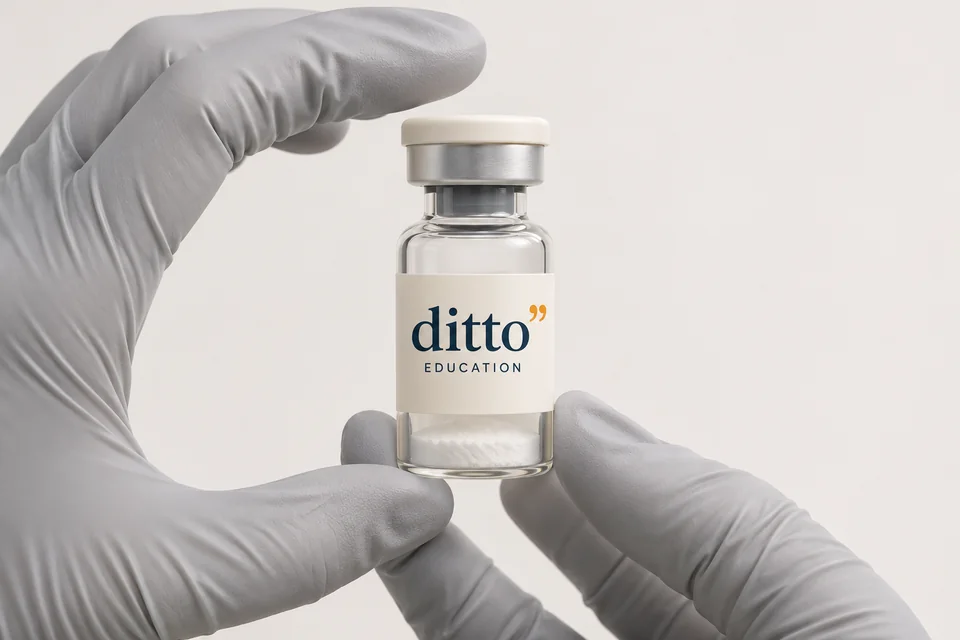
An illustrated reading aid for the product instructions. Confirm the exact formulation, diluent and handling method first. A research-only vial is not an approved medicine.
Check the exact product
Read the label, formulation, vial content, expiry and preparation instructions. Check the vial and closure for damage. Appearance alone cannot establish identity, purity or sterility.

Clean the stopper
If the product instructions call for vial access, disinfect the exposed rubber stopper with a fresh alcohol swab and let it dry. Avoid touching it afterward; use sterile equipment for each access.

Measure the specified diluent
Confirm the diluent type and volume in the product instructions. Measure that volume using the correct syringe scale. A concentration calculation cannot establish that a diluent is compatible.

Add as instructed
Follow the product-specific addition method. Where slow addition along the vial wall is specified, keep the flow gentle. Do not infer a preparation method from a dose table or combine separate compounds in one vial.

Mix and inspect
Use the mixing method specified for the product; some require gentle swirling rather than shaking. Compare the appearance with the instructions. Do not use a preparation with unexpected particles, discoloration or suspected contamination.

Record and store
Record the preparation date and calculated concentration in mg/mL and mcg/mL. Follow the exact storage conditions and discard time on the product instructions. There is no universal refrigerated shelf life for all peptides.
Record and store
Record the preparation date and calculated concentration in mg/mL and mcg/mL. Follow the exact storage conditions and discard time on the product instructions. There is no universal refrigerated shelf life for all peptides.
AI-generated educational scenes with Ditto-inspired concept labels; not photographs of supplied products. CDC preparation and equipment principles · Check your calculation
Reconstitution math reminder
Verify the math for the specific vial size and BAC water volume in your batch. A peptide reconstitution calculator is the safest way to confirm draw volumes before injecting.
KLOW Stack Dosage Chart
This KLOW Stack dosage chart summarizes the common pre-blended 80 mg (80,000 mcg) vial schedule, including the 50:10:10:10 GHK-Cu, KPV, BPC-157, and TB-500 ratio, the 3 mL reconstitution setup, and the once-daily reference dose range.
 UNIVERSITY OF PEPTIDE · RESEARCH REFERENCE
KLOW Stack Dosage Chart
| Phase | Draw volume | Total blend delivered | GHK-Cu | KPV | BPC-157 | TB-500 |
|---|---|---|---|---|---|---|
| Weeks 1-2 | 7.5 units (0.075 mL) | ~2.0 mg (2,000 mcg) total blend | ~1.25 mg (1,250 mcg) | ~250 mcg (0.25 mg) | ~250 mcg (0.25 mg) | ~250 mcg (0.25 mg) |
| Weeks 3-4 | 15 units (0.15 mL) | ~4.0 mg (4,000 mcg) total blend | ~2.5 mg (2,500 mcg) | ~500 mcg (0.5 mg) | ~500 mcg (0.5 mg) | ~500 mcg (0.5 mg) |
| Weeks 5-8 | 22.5 units (0.225 mL) | ~6.0 mg (6,000 mcg) total blend | ~3.75 mg (3,750 mcg) | ~750 mcg (0.75 mg) | ~750 mcg (0.75 mg) | ~750 mcg (0.75 mg) |
| Weeks 9-12 (taper) | 15 units (0.15 mL) | ~4.0 mg (4,000 mcg) total blend | ~2.5 mg (2,500 mcg) | ~500 mcg (0.5 mg) | ~500 mcg (0.5 mg) | ~500 mcg (0.5 mg) |
Why the KLOW Blend Adds KPV to the GLOW Stack
The GLOW stack pairs three regenerative peptides (GHK-Cu, BPC-157, TB-500) for a structural-repair and skin-rejuvenation focus. KLOW adds a fourth peptide, KPV, for a different reason: KPV's research focus is anti-inflammatory signaling, which the other three peptides do not directly target.
KPV is the C-terminal tripeptide fragment of alpha-melanocyte-stimulating hormone (alpha-MSH). In published preclinical work, KPV has been studied for inhibiting NF-κB activation in intestinal epithelial cells, with one widely cited study showing PepT1-mediated transport into colonic cells as part of its anti-inflammatory mechanism in mouse colitis models (Dalmasso et al., Gastroenterology, 2008).
BPC-157 and TB-500 also reduce inflammation in animal studies, but as a secondary effect of their tissue-repair pathways, not as a primary mechanism. GHK-Cu's anti-inflammatory effects flow through its broader gene-expression activity. KPV is the only one of the four that targets NF-κB-driven cytokine production directly.
Practical decision framing in the research-use community: if the research interest is structural repair, soft-tissue work, or skin remodeling alone, GLOW covers those bases. If the research context also involves chronic inflammation, gut-related models, or autoimmune-style settings, KPV is what KLOW adds.
Combination is not validated
No published study has tested whether GHK-Cu, KPV, BPC-157, and TB-500 act synergistically when administered together. The rationale above is mechanism-based community reasoning, not direct combination evidence.
KLOW Peptide Blend Side Effects & Safety
There are no published safety studies on the four-peptide KLOW combination. The information below is drawn from individual-compound research and community reports, separated into compound-level effects and stack-specific concerns.
Most Frequently Reported Effects
Subcutaneous peptide injections most commonly produce mild local effects: redness, mild swelling, or sensitivity at the injection site. A faint blue-green tint at the injection site is sometimes reported and is associated with the copper in GHK-Cu (cosmetic only). First-week mild fatigue and transient digestive shifts are also commonly described in user reports.
Less Commonly Reported Effects
Headache, light-headedness, vivid dreams (often attributed to BPC-157), and brief appetite changes are reported less frequently. None of these have been formally measured in a controlled study of the blend.
Stack-Specific Concerns
Copper accumulation (GHK-Cu)
GHK-Cu makes up 62.5% of the blend. Prolonged continuous use without an off period raises a theoretical risk of copper accumulation. Cycling 4-6 weeks on / 2-4 weeks off is the most common community-derived structure used to manage this.
Angiogenesis (BPC-157 and TB-500)
Both BPC-157 and TB-500 promote new blood vessel formation in animal models. This is the same mechanism that supports tissue repair, but it is a meaningful contraindication for anyone with active or recent malignancy.
Unknown interactions
No pharmacokinetic study has examined how the four peptides behave when injected together. Effects, timing, and any interactions are inferred, not measured.
Quality control
Research-use peptides are not held to pharmaceutical-grade manufacturing standards. Vial-to-vial purity, sterility, and accuracy of stated mass vary by supplier. Third-party Certificates of Analysis (COAs) reduce but do not eliminate this risk.
Common Contraindications
Active or recent cancer (BPC-157 and TB-500 angiogenesis concern), Wilson's disease or other copper metabolism disorders (GHK-Cu component), pregnancy or breastfeeding (no safety data for any component), and competitive sport at WADA-tested levels (BPC-157 and TB-500 are listed under WADA category S0 — Unapproved Substances) are commonly cited reasons not to research KLOW. Anyone on anticoagulants should be especially cautious with the angiogenesis-active components.
Stop and reassess
Stop the protocol and seek qualified medical care if pronounced symptoms appear: significant swelling, ongoing dizziness, rapid heart rate, shortness of breath, or marked fatigue.
KLOW Peptide Blend Clinical Evidence Context
No direct evidence: No published human or animal trial has evaluated the four-peptide KLOW combination. Every claim about the blend is extrapolated from individual-compound research, anecdotal community reports, or supplier marketing material. This is the most important boundary on this page.
Compound-Level Evidence
GHK-Cu
A 2018 review in the International Journal of Molecular Sciences synthesized gene-expression data showing GHK-Cu modulates over 4,000 human genes (Pickart and Margolina). Animal and ex-vivo human skin studies have reported increased collagen and elastin synthesis. Most clinical evidence is topical-formulation cosmetic research, not injectable. For topical research context, the archived review breaks down Free research tools.
KPV
Mechanism evidence comes from cell and animal studies. Dalmasso et al. (Gastroenterology, 2008) showed KPV reduces NF-κB activation and is taken up via PepT1 in mouse colitis models. No FDA-approved KPV drug exists.
BPC-157
A 2024 systematic review in HSS Journal (Vasireddi et al.) identified 36 included studies — 35 preclinical, 1 small clinical — across nearly three decades. Preclinical models report tendon, ligament, muscle, and gut healing benefits, but human evidence remains limited to a handful of small open-label pilot studies.
TB-500 / Thymosin beta-4
Goldstein and colleagues established thymosin beta-4 as the principal G-actin-sequestering peptide in mammalian cells. Preclinical work documents accelerated wound healing, cardiac repair after infarction, and corneal healing. Most human trials use the full 43-amino-acid thymosin beta-4 (RGN-259, RGN-137), not the TB-500 fragment.
Compound-level evidence does not validate a stack. Even if each peptide has independent research support, the combination has not been studied for synergy, antagonism, pharmacokinetic interaction, or safety. Anyone reading the literature should treat KLOW as a research-context blend, not as a clinically validated protocol.
KLOW Peptide Blend Storage & Handling
KLOW Storage at a Glance
| State | Storage | Notes |
|---|---|---|
| Lyophilized (powder) | -4 F (-20 C) long-term; refrigerator acceptable short-term | Keep dry, dark, in original packaging. |
| Reconstituted (liquid) | 35.6-46.4 F (2-8 C) refrigerated | Use within 14-28 days; do not freeze. |
| Appearance | Clear; light blue tint possible | Discoloration beyond a faint blue-green hint suggests contamination. |
Allow lyophilized vials to reach room temperature before reconstitution to reduce condensation moisture.
Avoid repeated freeze-thaw cycles in the reconstituted form — every freeze-thaw cycle damages peptide structure and reduces potency. Keep the vial protected from direct light during cold storage.
KLOW vs GLOW vs Wolverine Stack
KLOW is most often compared to two nearby blends. The choice usually comes down to whether KPV's anti-inflammatory mechanism is part of the research interest.
KLOW vs GLOW vs Wolverine Stack
| Feature | Wolverine Stack | GLOW Stack | KLOW Blend |
|---|---|---|---|
| Components | BPC-157 + TB-500 | GHK-Cu + BPC-157 + TB-500 | GHK-Cu + KPV + BPC-157 + TB-500 |
| Total vial mass (typical) | 10-20 mg (10,000-20,000 mcg) | 70 mg (70,000 mcg) | 80 mg (80,000 mcg) |
| Primary research focus | Soft-tissue repair | Skin + tissue + recovery | Skin + tissue + anti-inflammatory |
| Adds KPV (anti-inflammatory) | No | No | Yes |
| Adds GHK-Cu (collagen / gene expression) | No | Yes | Yes |
| Number of injections | 1 | 1 | 1 |
These are the most common community framings; vial mass varies by supplier.
If the research interest centers on tendon, muscle, or post-injury repair, the BPC-157 and TB-500 Wolverine base is the simplest entry point. If skin/connective-tissue research is the focus, GLOW adds GHK-Cu. KLOW is the choice when the research scope also touches on inflammatory signaling — KPV is the differentiator.
KLOW Stack Blood Tests & Monitoring
The KLOW Stack combines GHK-Cu, KPV, BPC-157, and TB-500, so monitoring should cover immune/inflammatory context, tissue-repair context, and copper exposure. Labs can support broad review but may not capture local tissue or gut response.
Blood test markers to discuss with a clinician
| Marker | Why it matters | Timing |
|---|---|---|
| CBC with differential | Screens blood-cell patterns, infection context, anemia, and immune changes. | Baseline |
| Comprehensive metabolic panel (CMP) | Reviews liver, kidney, electrolyte, and glucose context in one broad panel. | Baseline |
| CRP | Adds a broad inflammation marker when gut, skin, immune, or injury symptoms are part of the question. | Follow-up |
| ESR | Provides a slower-moving inflammation marker for chronic inflammatory symptoms. | Optional |
| Copper and ceruloplasmin | Adds copper-status context when repeated high-exposure GHK-Cu use is being discussed. | Optional |
Monitoring guidance combines immune, inflammation, tissue-repair, and copper-context pathway logic for the listed stack components.
At-home blood test option
Easy at home option to monitor core metrics during research cycles.
Beyond Whoosh
Pharmacy Grade KLOW Stack
Prescription-grade peptide care through Beyond Whoosh. Whoosh prescribes after a clinician reviews your eligibility.
Simple timing framework
- Baseline
- Discuss baseline labs before starting, especially with autoimmune disease, gut symptoms, active injury, infection concern, liver disease, kidney disease, or copper concerns.
- Follow-up
- Repeat broad and inflammation markers after 6-12 weeks if symptoms change or the protocol continues.
- Longer term
- For longer repeated exposure, review broad health, inflammation, and copper-context markers every 3-6 months with a clinician.
How to interpret the labs
- Autoimmune disease, infection risk, immune medications, and copper exposure from supplements should be reviewed clinically.
- Routine labs may look normal even when local gut, skin, or connective-tissue symptoms remain.
- Avoid positioning this stack as a treatment or cure for inflammatory disease.
Do not wait for routine labs
Fever, bloody stool, severe abdominal pain, spreading rash, jaundice, allergic symptoms, or severe wound changes need medical review.
FAQ
Q1: What is the KLOW peptide blend?
KLOW is a research-context name for a four-peptide blend that combines GHK-Cu, KPV, BPC-157, and TB-500 in a single vial. The standard format is an 80 mg (80,000 mcg) vial split as 50 mg (50,000 mcg) GHK-Cu, 10 mg (10,000 mcg) KPV, 10 mg (10,000 mcg) BPC-157, and 10 mg (10,000 mcg) TB-500. KLOW is not an FDA-approved treatment and no published clinical trial has evaluated the four-peptide combination together.
Q2: What does the KLOW peptide blend research focus on?
Community discussion of KLOW most often centers on tissue-repair research, skin/connective-tissue remodeling, recovery research, and anti-inflammatory research. These are research-context interests, not validated clinical outcomes. Direct human evidence for the KLOW combination does not exist.
Q3: How is the KLOW peptide blend dosed in research planning?
Most community protocols reconstitute the 80 mg (80,000 mcg) vial with 3.0 mL bacteriostatic water (about 26.7 mg/mL (26,700 mcg/mL) total blend) and use once-daily subcutaneous injections starting at small volumes. The table above shows about 250-750 mcg (0.25-0.75 mg) each of KPV, BPC-157, and TB-500, alongside 1.25-3.75 mg (1,250-3,750 mcg) of GHK-Cu per daily draw. None of these are dose recommendations.
Q4: How much bacteriostatic water do you add to an 80 mg (80,000 mcg) KLOW vial?
Most community protocols add 3.0 mL of bacteriostatic water. That makes about 26.7 mg/mL (26,700 mcg/mL) of total blend. Some use 2.5 mL, which makes 32.0 mg/mL (32,000 mcg/mL). With less water, the same amount fits in a smaller draw. For example, about 2.0 mg (2,000 mcg) of blend is 7.5 units at 3.0 mL, or about 6.25 units at 2.5 mL. These figures are for research reference only and are not dose recommendations.
Q5: What is the difference between KLOW and GLOW peptides?
GLOW is a three-peptide blend with GHK-Cu, BPC-157, and TB-500. KLOW adds a fourth peptide, KPV. The KPV component is what distinguishes KLOW — its research focus is on anti-inflammatory signaling (NF-κB inhibition, PepT1-mediated transport in gut models). When chronic inflammation is part of the research interest, KLOW is the more common choice; otherwise GLOW covers the same regenerative components.
Q6: How long is a typical KLOW cycle?
Community-derived cycle structures most often run 4-6 weeks on followed by 2-4 weeks off. Some protocols extend to 8-12 weeks with longer off periods. The off period is mainly there to address copper-accumulation concern from the GHK-Cu component, which makes up 62.5% of the blend. See the full KLOW cycle-length guide for a comparison of 4-, 6-, 8-12-, and 16-week schedules.
Q7: How is the KLOW peptide blend reconstituted?
The most common research-context approach is to add 3.0 mL of bacteriostatic water to the 80 mg (80,000 mcg) KLOW vial. This produces about 26.7 mg/mL (26,700 mcg/mL) total blend. The mix is swirled gently — never shaken — and stored refrigerated at 35.6-46.4 F (2-8 C). A peptide reconstitution calculator is the safest way to confirm draw volumes for a specific vial size.
Q8: Is the KLOW peptide blend FDA-approved?
No. As of June 2026, none of the four peptides in KLOW are FDA-approved for the indications discussed in the research community. BPC-157 and TB-500 are also listed by WADA under category S0 (Unapproved Substances) and are prohibited in tested sport.
Q9: What supplies are needed for a KLOW protocol?
A common research-context setup includes 80 mg (80,000 mcg) KLOW vials, bacteriostatic water, U-100 insulin syringes (one per daily injection), and alcohol prep pads (two per injection). At the 22.5-unit daily draw used in the supply table, 8 weeks needs at least 5 vials by total amount, 15 mL of BAC water, 56 syringes, and 112 swabs. Allow extra for losses and the time limit after mixing.
Q10: Who should avoid the KLOW peptide blend?
Common contraindications cited in the research-use community include: anyone with active or recent cancer (BPC-157 and TB-500 promote angiogenesis), people with Wilson's disease or other copper-metabolism disorders (GHK-Cu component), anyone pregnant or breastfeeding (no safety data), and athletes subject to WADA testing (BPC-157 and TB-500 are prohibited).
Q11: Is the KLOW peptide blend medical advice?
No. This page is an educational research reference, not medical advice. KLOW is not an FDA-approved treatment. Anyone considering peptide research should work within their applicable regulations and seek qualified medical guidance.
Sources & Research
- Pickart L, Margolina A. Regenerative and Protective Actions of the GHK-Cu Peptide in the Light of the New Gene Data. International Journal of Molecular Sciences (2018)
- Pickart L. GHK Peptide as a Natural Modulator of Multiple Cellular Pathways in Skin Regeneration. BioMed Research International (2015)
- Dou Y, et al. The potential of GHK as an anti-aging peptide. Aging Pathobiology and Therapeutics (2022)
- Dalmasso G, Charrier-Hisamuddin L, Nguyen HT, et al. PepT1-Mediated Tripeptide KPV Uptake Reduces Intestinal Inflammation. Gastroenterology (2008)
- Brzoska T, Luger TA, Maaser C, Abels C, Bohm M. Alpha-MSH related peptides: a new class of anti-inflammatory and immunomodulating drugs. British Journal of Pharmacology / NIHMS PMC (2008)
- Xiao B, Xu Z, Viennois E, et al. Orally Targeted Delivery of Tripeptide KPV via Hyaluronic Acid-Functionalized Nanoparticles Efficiently Alleviates Ulcerative Colitis. Molecular Therapy / PMC (2017)
- Vasireddi N, Hahamyan H, Salata MJ, et al. Emerging Use of BPC-157 in Orthopaedic Sports Medicine: A Systematic Review. HSS Journal (2025)
- Various authors. Regeneration or Risk? A Narrative Review of BPC-157 for Musculoskeletal Healing. Cureus / PMC (2024)
- Malinda KM, Sidhu GS, Mani H, et al. Thymosin beta4 accelerates wound healing. Journal of Investigative Dermatology (1999)
- Goldstein AL, Hannappel E, Sosne G, Kleinman HK. Thymosin beta4: a multi-functional regenerative peptide. Basic properties and clinical applications. Expert Opinion on Biological Therapy (2012)
- Sosne G, Qiu P, Goldstein AL, Wheater M. Thymosin beta 4: A novel corneal wound healing and anti-inflammatory agent. Clinical Ophthalmology / PMC (2007)
- U.S. Food and Drug Administration. 503A Bulks List Final Rule and 503B Bulk Drug Substances - peptide categorization references. FDA (2026)
- World Anti-Doping Agency. WADA Prohibited List - Section S0 Unapproved Substances (BPC-157, TB-500 categorization). WADA (2026)
Related Dosing Protocols
Reconstitution calculator
Enter your own values. This tool calculates quantities, not a recommended dose.
Check the concentration
Changing the unit keeps the entered mass equivalent. 1 milligram (mg) = 1,000 micrograms (mcg). This tool does not choose a target amount.
Biological IU (optional, product-specific)
Only enter a potency explicitly stated as IU per mg on the exact product label or reference. Do not enter the 100 from a U-100 syringe. No factor is assumed for any peptide.
Your result will appear here
Enter the mass, final solution volume and target mass, or load a fictional example.
Assumes accurate masses, final solution volume and even distribution. Blend arithmetic does not establish whether substances can be mixed. Read the formulas and assumptions.
Study findings, reported examples and supplier statements have different levels of evidence. Follow the citations and check the formulation, population and date before interpreting a number.
Editorial standards and corrections