On this page
TOOLS FOR THIS GUIDE
Work with ARA-290
The guide name carries across. Amounts, dates and instructions remain yours to enter; opening a tool saves nothing.
Worked examples: calculations, records and source checks
Fictional arithmetic, unrelated to a recommended amount of ARA-290: 10 mg (10,000 mcg) in a final 2 mL is 5 mg/mL (5,000 mcg/mL). A target mass of 0.25 mg (250 mcg) corresponds to 0.05 mL, or 5 U-100 syringe markings. Biological IU cannot be inferred from these inputs. Neither the mass nor the liquid is a preparation recommendation.
Open the arithmetic example- Supply example: two 10 mg (10,000 mcg) vials start at 20 mg (20,000 mcg). Four recorded entries of 0.25 mg (250 mcg) leave a theoretical 19 mg (19,000 mcg), before losses or expiry. Skipped entries do not deduct stock.
- Measurement example: enter “Sleep duration”, “7.5”, “hours” and the date. Keep the same unit and note changing conditions. A trend does not prove a treatment effect.
- Source example: record “rat study” when rats were studied, even when the headline describes recovery. Keep the exact paper and its limitations.
The planner accepts mg and mcg. Biological IU/USP units, sprays, drops and variable mixtures need product-specific instructions; they cannot be inferred from a generic mass calculator. For stacks, record each known ingredient separately.
FDA: why concentration and unit errors matterEvidence & source checks
ARA-290: source check
A blinded trial in sarcoidosis-associated small-fiber nerve loss reported symptom and corneal nerve-fiber changes after 28 days.
Limit: The specific disease, short duration and studied formulation limit extrapolation to other neuropathies or healthy users.
Question to resolve: Does the population and the measured nerve outcome match the question being asked?
Source and reading scope
ARA 290 improves symptoms in patients with sarcoidosis-associated small nerve fiber loss and increases corneal nerve fiber density.
PubMed abstract; not an independent clinical review. Checked 25 November 2026.
What to verify before filling a plan
- Identity and formulation: match the name, sequence or active ingredient, route and strength. A related molecule or branded medicine is not automatically equivalent.
- Instruction source: obtain the actual amount, frequency and duration from qualified medical instructions. A community table or trial protocol does not establish an individual regimen.
- Units and product details: keep mass, liquid volume and biological activity units separate. Record batch, storage and discard instructions from the actual product; the tools cannot determine sterility or stability.
- Review and follow-up: list medicines and supplements, unresolved interactions and questions. Agree on relevant observations and actions with a qualified professional; normal measurements do not prove safety.
Selected source context, not a systematic review or medical approval. Study cards checked 24 November 2026; guide source notes checked 25 November 2026. Research references and citations appear below.
Guide summary
REFERENCE SUMMARY- Compound
- ARA-290 (cibinetide)
- Class
- Non-erythropoietic EPO-derived peptide (IRR agonist)
- Common format
- Lyophilized powder, subQ daily
- Regulatory status
- Not FDA-approved; orphan/fast-track only
ARA-290 Quick Start
ARA-290, also called cibinetide, is a small 11-amino-acid peptide built from one piece of the erythropoietin (EPO) molecule. It was engineered to keep EPO's tissue-repair and anti-inflammatory signaling while removing the part that makes red blood cells. In research it is given as a subcutaneous injection from a reconstituted vial.
ARA-290 has more human trial data than many research peptides, especially for sarcoidosis- and diabetes-related nerve symptoms. Development later stalled after Phase 2, with no Phase 3 trial or approval.
- What it is
- An EPO-derived, non-erythropoietic innate-repair-receptor agonist.
- Route
- Subcutaneous injection; early trials also used IV.
- Trial doses
- 1-8 mg (1,000-8,000 mcg) daily subQ in Phase 2; 4 mg (4,000 mcg) was central.
- Research status
- Not FDA-approved; orphan/fast-track only; development stalled.
Educational research reference only
This page summarizes how ARA-290 was dosed in research and is discussed in the research community. It is not medical advice, a prescription, or a treatment plan. ARA-290 is not FDA-approved for human use. Talk to a qualified clinician before using any peptide.
ARA-290 Dosing Protocol & Schedule
ARA-290 dosing is easier to anchor than many peptides because published trials and common research-community protocols use similar ranges. Human studies used daily subcutaneous injections from 1-8 mg (1,000-8,000 mcg), with 4 mg/day (4,000 mcg/day) appearing most often.
Doses used in ARA-290 human trials
| Study context | Dose & route | Schedule |
|---|---|---|
| Sarcoidosis pilot (2012) | 2 mg (2,000 mcg) IV | 3x/week, 4 weeks |
| Sarcoidosis SFN (2013) | Daily subQ | 28 days |
| Type 2 diabetes neuropathy (2014) | 4 mg (4,000 mcg) subQ | Daily, 28 days |
| Phase 2b sarcoidosis (2017) | 1, 4, or 8 mg (8,000 mcg) subQ | Daily, 28 days |
| Diabetic macular edema (2020) | 4 mg (4,000 mcg) subQ | Daily, 12 weeks |
This is trial reporting, not a dosing recommendation. Most later trials used daily subcutaneous injection; the earliest used IV.
Community-derived subQ structure
| Item | Commonly reported |
|---|---|
| Typical range | 1-4 mg/day (1,000-4,000 mcg/day) |
| Higher range cited | Up to 8 mg/day (8,000 mcg/day) (trial ceiling) |
| Frequency | Once daily |
| Cycle length | About 4 weeks, matching trial blocks |
| Route | Subcutaneous injection |
Community figures mirror the trial doses. Because most trials listed here ran for 28 days, longer-term safety at these doses is not established.
Where it is injected
In trials and community use, ARA-290 is given subcutaneously, typically into the fat of the lower abdomen or thigh with a small insulin syringe. Site rotation is commonly reported in trials and community use as a way to reduce local irritation.
ARA-290 Supplies Needed
These supply estimates use a 16 mg (16,000 mcg) vial mixed with 2 mL BAC water, giving 8 mg/mL (8,000 mcg/mL). At 4 mg/day (4,000 mcg/day), each vial provides about 4 doses. Lower doses stretch each vial further, but only mix what you can use within about 14 days.
Recommended Supply
Choose your region
Use discount code SAVE10 at Peptira checkout. See why we love Peptira.
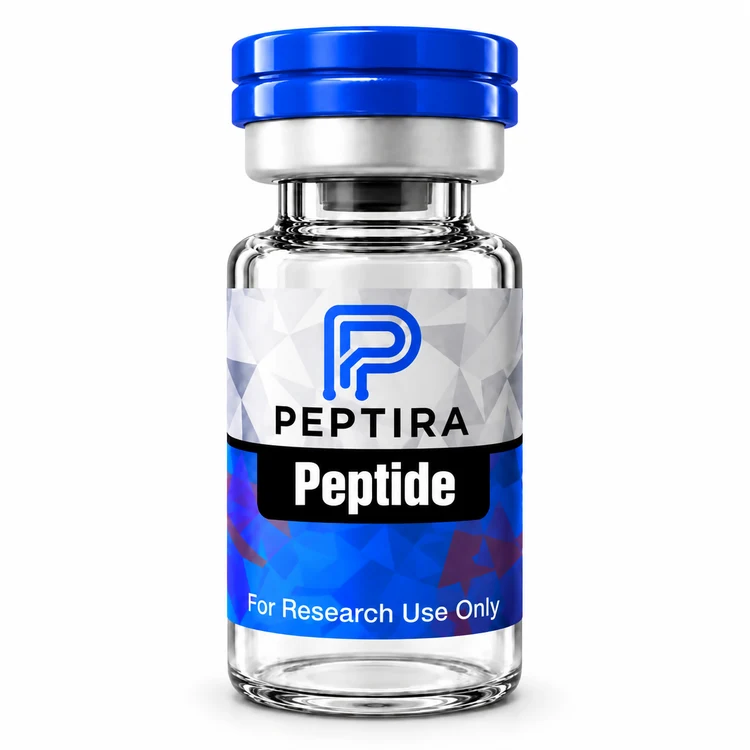
ARA-290

At-Home Blood Test
Research Supplies
Peptide Vials
Based on a 16 mg (16,000 mcg) vial and a representative 4 mg (4,000 mcg) daily dose, one vial gives about 4 doses.
| Cycle length | Planning note |
|---|---|
2 weeks 4 vials | 14 doses needed at 4 mg/day (4,000 mcg/day) |
4 weeks 7 vials | 28 doses needed at 4 mg/day (4,000 mcg/day) |
6 weeks 11 vials | 42 doses needed at 4 mg/day (4,000 mcg/day) |
8 weeks 14 vials | 56 doses needed at 4 mg/day (4,000 mcg/day) |
Insulin Syringes (U-100)
One syringe per daily injection. A 0.5 mL / 50-unit syringe fits a 4 mg (4,000 mcg) draw at 8 mg/mL (8,000 mcg/mL).
| Cycle length | Planning note |
|---|---|
2 weeks 14 syringes | 1 per day |
4 weeks 28 syringes | 1 per day |
Bacteriostatic Water
Use 2 mL per 16 mg (16,000 mcg) vial for reconstitution.
| Cycle length | Planning note |
|---|---|
2 weeks 1 x 10 mL bottle | 4 vials use 8 mL |
4 weeks 2 x 10 mL bottles | 7 vials use 14 mL |
Vial counts shown are for 4 mg/day (4,000 mcg/day); at 1-2 mg/day (1,000-2,000 mcg/day) you need far fewer. Round up for priming losses and dropped syringes, and do not mix more than you can use within about 14 days.
Companion Supplies & Routine Support
ARA-290 Reconstitution Guide
Reconstitution turns the dry powder into a measurable liquid. Concentration is vial size divided by BAC water. Draw volume is target dose divided by concentration. U-100 units are milliliters multiplied by 100.
Example: a 16 mg (16,000 mcg) vial plus 2 mL of BAC water gives 8 mg/mL (8,000 mcg/mL). A 4 mg (4,000 mcg) dose is then 0.5 mL, which is 50 units on a U-100 syringe. A 10 mg (10,000 mcg) vial plus 2 mL gives 5 mg/mL (5,000 mcg/mL), so 4 mg (4,000 mcg) becomes 0.8 mL, or 80 units.
Draw volume by dose at 8 mg/mL (8,000 mcg/mL) (16 mg (16,000 mcg) vial + 2 mL)
| Dose | Volume | U-100 units |
|---|---|---|
| 1 mg (1,000 mcg) | 0.13 mL | ~13 units |
| 2 mg (2,000 mcg) | 0.25 mL | 25 units |
| 4 mg (4,000 mcg) | 0.50 mL | 50 units |
For a 10 mg (10,000 mcg) vial with 2 mL water (5 mg/mL (5,000 mcg/mL)): 2 mg (2,000 mcg) = 0.4 mL (40 units) and 4 mg (4,000 mcg) = 0.8 mL (80 units). Use less water for a more concentrated mix and smaller draws.
An illustrated reading aid for the product instructions. Confirm the exact formulation, diluent and handling method first. A research-only vial is not an approved medicine.
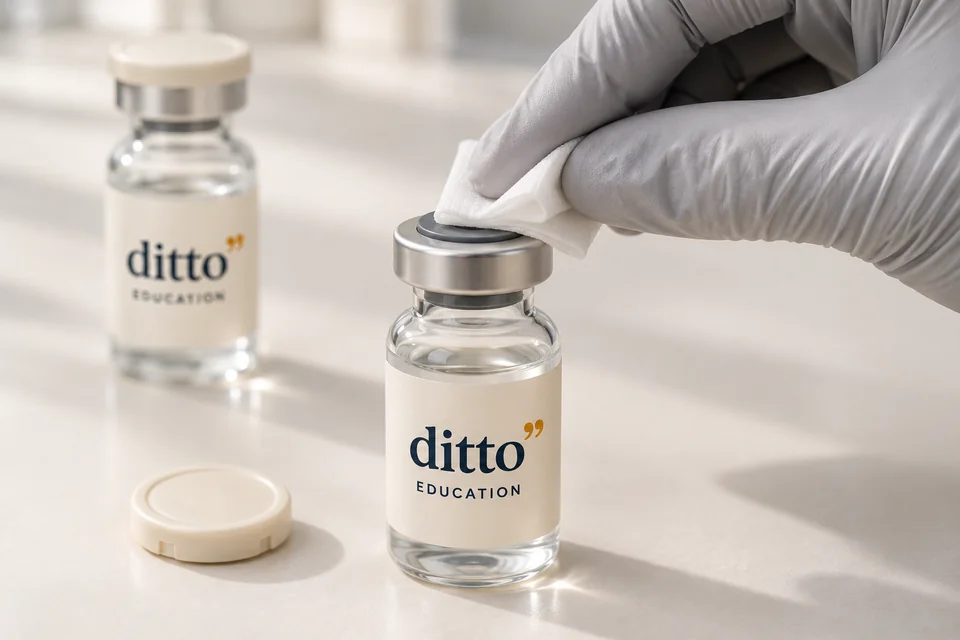
Clean the stopper
If the product instructions call for vial access, disinfect the exposed rubber stopper with a fresh alcohol swab and let it dry. Avoid touching it afterward; use sterile equipment for each access.
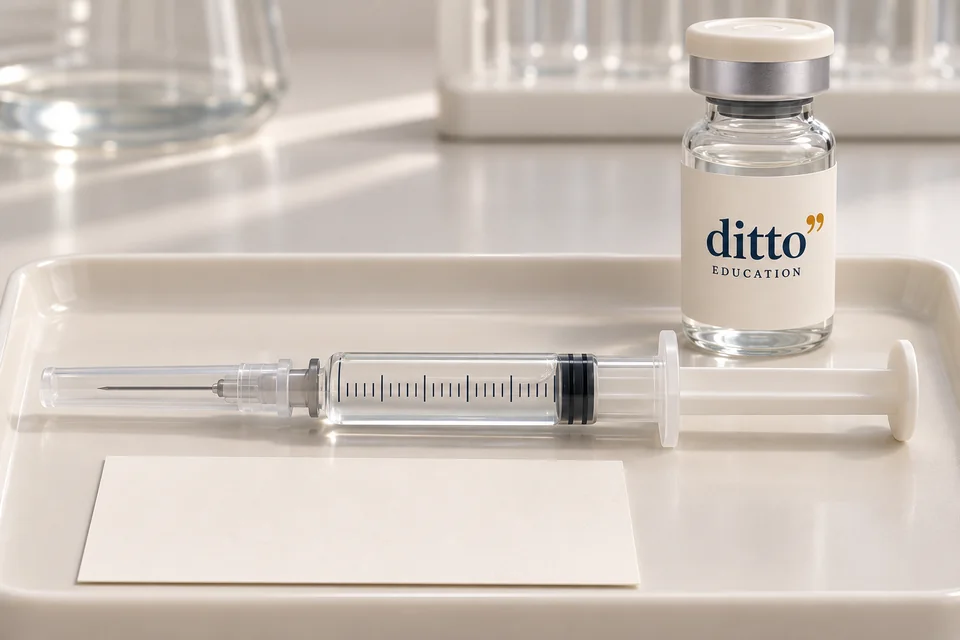
Measure the specified diluent
Confirm the diluent type and volume in the product instructions. Measure that volume using the correct syringe scale. A concentration calculation cannot establish that a diluent is compatible.
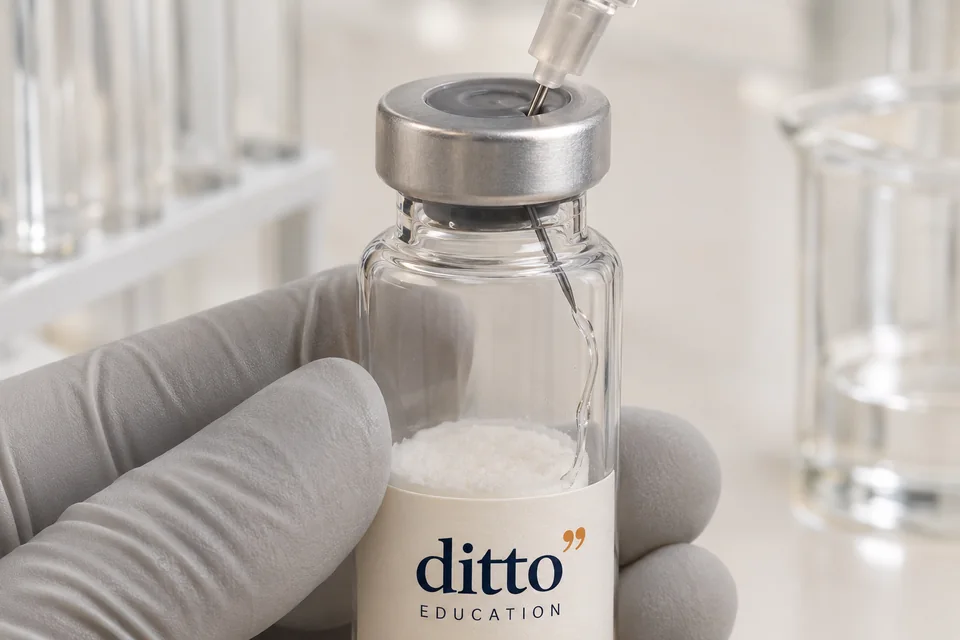
Add as instructed
Follow the product-specific addition method. Where slow addition along the vial wall is specified, keep the flow gentle. Do not infer a preparation method from a dose table or combine separate compounds in one vial.
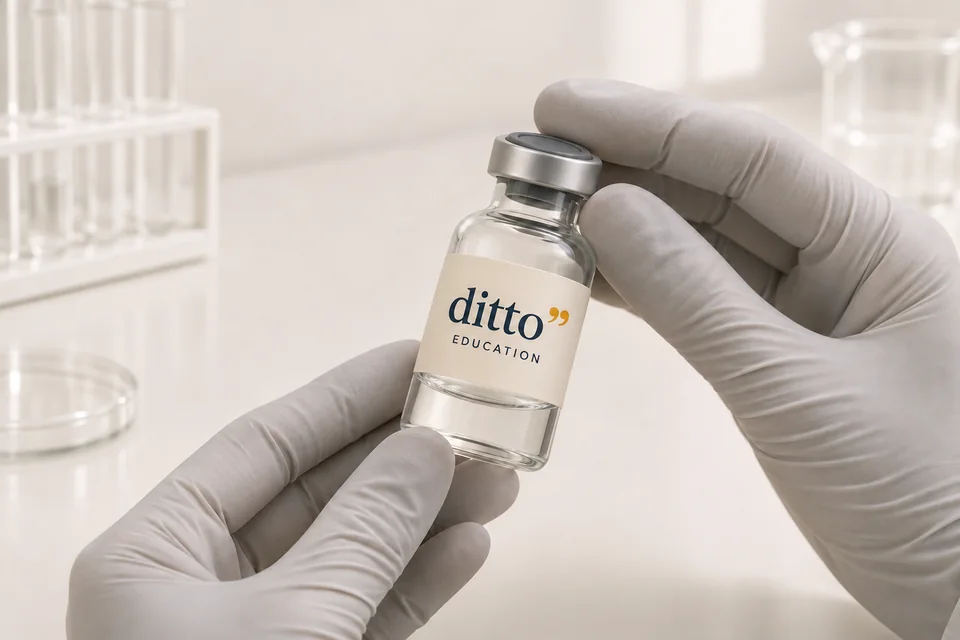
Mix and inspect
Use the mixing method specified for the product; some require gentle swirling rather than shaking. Compare the appearance with the instructions. Do not use a preparation with unexpected particles, discoloration or suspected contamination.
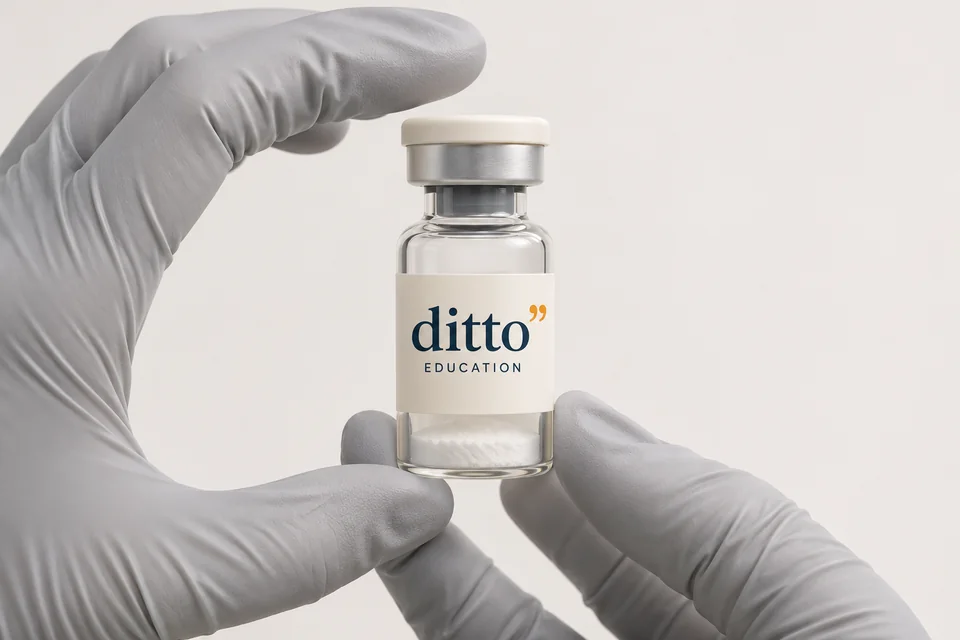
Check the exact product
Read the label, formulation, vial content, expiry and preparation instructions. Check the vial and closure for damage. Appearance alone cannot establish identity, purity or sterility.
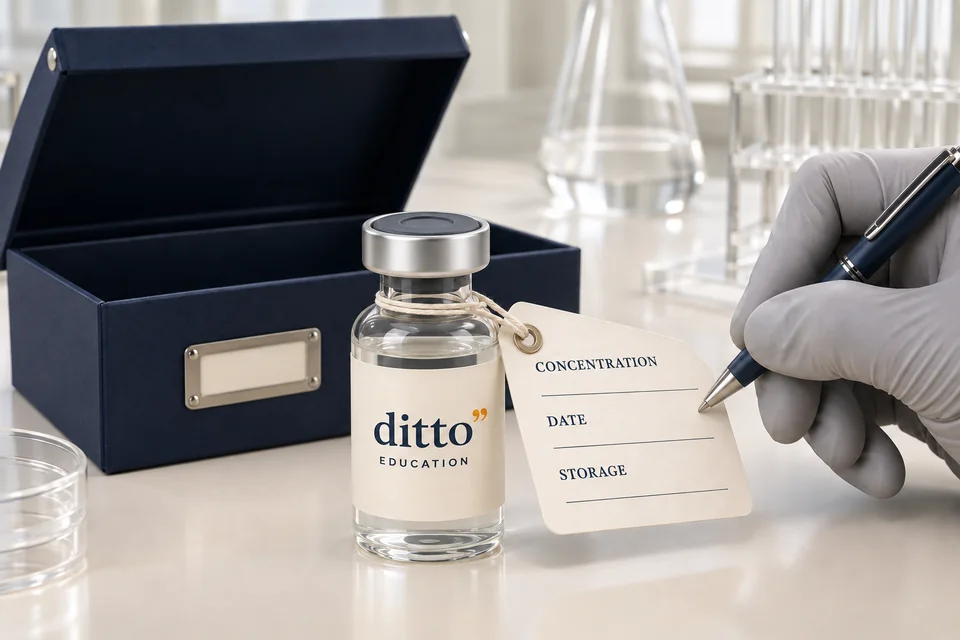
Record and store
Record the preparation date and calculated concentration in mg/mL and mcg/mL. Follow the exact storage conditions and discard time on the product instructions. There is no universal refrigerated shelf life for all peptides.
Record and store
Record the preparation date and calculated concentration in mg/mL and mcg/mL. Follow the exact storage conditions and discard time on the product instructions. There is no universal refrigerated shelf life for all peptides.
AI-generated educational scenes with Ditto-inspired concept labels; not photographs of supplied products. CDC preparation and equipment principles · Check your calculation
Calculator
Use a reconstitution calculator to match your exact vial size, BAC water volume, and target dose to milliliters and U-100 units.
ARA-290 Dosage Chart
This chart summarizes the daily subcutaneous dosing pattern discussed above, including the reported range, cycle length, and route.
 UNIVERSITY OF PEPTIDE · RESEARCH REFERENCE
ARA-290 Dosage Chart
| Study context | Dose & route | Schedule |
|---|---|---|
| Sarcoidosis pilot (2012) | 2 mg (2,000 mcg) IV | 3x/week, 4 weeks |
| Sarcoidosis SFN (2013) | Daily subQ | 28 days |
| Type 2 diabetes neuropathy (2014) | 4 mg (4,000 mcg) subQ | Daily, 28 days |
| Phase 2b sarcoidosis (2017) | 1, 4, or 8 mg (8,000 mcg) subQ | Daily, 28 days |
| Diabetic macular edema (2020) | 4 mg (4,000 mcg) subQ | Daily, 12 weeks |
How ARA-290 Works
In plain terms, EPO does two separate jobs. One job tells bone marrow to make red blood cells. The other job protects and repairs injured tissue and calms inflammation. ARA-290 was designed to trigger only the second job.
It does this by selectively activating the innate repair receptor (IRR), a receptor complex made of the EPO receptor paired with the beta-common receptor (CD131). This is different from the classic EPO receptor pair that drives red-blood-cell production, which is why ARA-290 does not raise hematocrit. ARA-290 also appears to quiet the TRPV1 pain channel on small nerve fibers, which helps explain its effect on neuropathic pain.
- Selectively activates the innate repair receptor (EPOR + CD131).
- Drives anti-inflammatory, cytoprotective, and tissue-repair signaling.
- Does not stimulate red-blood-cell production (non-erythropoietic).
- Antagonizes the TRPV1 channel, linked to its pain effect.
Who Should Be Cautious With ARA-290
ARA-290 was generally well tolerated in short human trials, but the available safety data is limited to small groups and relatively brief study windows. These cautions are conservative research context, not a medical screening tool.
- Anyone who is pregnant or breastfeeding — there is no safety data.
- People with active cancer or blood disorders such as myeloproliferative conditions, given the EPO-derived design, as a conservative precaution.
- Anyone on other injectable therapies without clinician oversight.
- Anyone with a history of strong reactions to injected peptides.
Talk to a clinician
ARA-290 is not FDA-approved and has no established long-term safety profile. These cautions are drawn from its EPO lineage and general peptide-injection risks, not from a safety label.
ARA-290 Side Effects & Safety
Across the Phase 2 trials, ARA-290 was generally well tolerated. Reported effects were mostly mild and short-lived, and no serious drug-related safety problems were flagged in the published studies.
- Mild, transient injection-site reactions (redness or discomfort).
- Occasional headache reported at low frequency.
- No rise in red blood cells or hematocrit, by design.
- No anti-drug antibodies detected in the diabetic macular edema trial.
The important caveat is scale. Combined trial enrollment was under about 200 people, and treatment periods were short. That means long-term safety at any dose is simply not characterized.
ARA-290 Expected Timeline & Monitoring
The trial timelines are short and specific. Most studies ran daily subcutaneous ARA-290 for 28 days. In the Phase 2b sarcoidosis trial, measurable nerve-fiber regrowth on corneal imaging and pain improvement were seen within that 28-day window. In the diabetes trial, some benefits persisted through a 28-day follow-up after dosing stopped.
For research planning, the main things to track are symptom scores, injection-site reactions, and any unexpected side effects. Because the compound is EPO-derived, some researchers also note red-blood-cell parameters as a precaution, even though trials showed no erythropoietic effect.
ARA-290 Clinical Evidence Context
ARA-290 has more human evidence than many peptides covered in research guides, but the evidence base is still small and stops at Phase 2. All the main trials were run or sponsored by the developer, Araim Pharmaceuticals.
Human ARA-290 (cibinetide) trials
| Study | Design | Key result |
|---|---|---|
| Sarcoidosis pilot (2012) | 22 patients, IV 2 mg (2,000 mcg) 3x/week, 4 weeks | Improved neuropathy symptom score; safe |
| Sarcoidosis SFN (2013) | Daily subQ, 28 days, placebo-controlled | Better symptoms; increased corneal nerve fiber density |
| Type 2 diabetes (2014) | 4 mg (4,000 mcg) subQ daily, 28 days | Improved neuropathic symptoms, HbA1c, lipids, nerve density |
| Phase 2b sarcoidosis (2017) | 64 patients, 1/4/8 mg subQ daily, 28 days | Met primary corneal nerve-regeneration endpoint; less pain |
| Diabetic macular edema (2020) | 4 mg (4,000 mcg) subQ daily, 12 weeks, 9 patients | No serious adverse events; small uncontrolled pilot |
All trials were Phase 2 or smaller, mostly single-institution, and short in duration.
The main limitation is the missing next step: no Phase 3 trial was completed, and the developer reportedly wound down operations with no active US IND as of 2026. That leaves promising Phase 2 signals for nerve pain and regeneration, but no completed approval path. Popular claims about broad anti-aging or bodybuilding benefits are not supported by these trials.
The evidence boundary
Human proof exists at the Phase 2 level for nerve-related endpoints in sarcoidosis and diabetes. It does not extend to Phase 3, to long-term safety, or to general wellness and performance claims.
ARA-290 Storage & Handling
ARA-290 storage
Lyophilized (Powder Form)
ARA-290 (cibinetide)
-4F (-20C) long-term
Reconstituted (Liquid Form)
ARA-290 (cibinetide)
35.6-46.4F (2-8C), use within ~14 days
Light
ARA-290 (cibinetide)
Protect from light
Appearance
ARA-290 (cibinetide)
Clear, colorless when mixed
| ARA-290 (cibinetide) | |
|---|---|
| Lyophilized (Powder Form) | -4F (-20C) long-term |
| Reconstituted (Liquid Form) | 35.6-46.4F (2-8C), use within ~14 days |
| Light | Protect from light |
| Appearance | Clear, colorless when mixed |
Keep reconstituted vials cold and out of light, and discard any solution that turns cloudy or is past its window.
ARA-290 Troubleshooting
- Cloudy or particle-filled solution: discard it; only use a clear, colorless solution.
- Draw looks too large at 4 mg (4,000 mcg): use less BAC water for a more concentrated vial, so the same dose is a smaller volume.
- Vial will not last the cycle: plan for multiple vials, since ARA-290 is milligram-heavy relative to typical vial sizes; do not keep a mixed vial past about 14 days.
- Injection-site irritation is commonly addressed in reports by rotating sites and injecting slowly.
ARA-290 Regulatory Status
As of July 2026, ARA-290 (cibinetide) is not FDA-approved for any indication. It received FDA Orphan Drug and Fast Track designations for neuropathic pain in sarcoidosis, plus EU orphan designation, but those are development incentives, not approvals. No NDA or BLA was ever submitted.
Multiple industry and reference sources report that the developer, Araim Pharmaceuticals, has wound down, with no active US IND and no Phase 3 program. Reporting attributes the stall to commercial and organizational factors rather than a specific safety problem. ARA-290 sold as a research peptide is a research-use-only product, not an approved medicine, and is not the same as a licensed formulation.
ARA-290 vs BPC-157 and Nearby Peptides
ARA-290 is often compared to BPC-157 because both are discussed for repair. They are quite different. BPC-157 is a broad soft-tissue recovery peptide with mostly animal evidence. ARA-290 is a targeted innate-repair-receptor agonist with actual human Phase 2 data, but focused on nerve and inflammatory endpoints rather than general tissue repair.
Where ARA-290 sits
| Peptide | Main research framing | Best human evidence |
|---|---|---|
| ARA-290 | Nerve repair, neuropathic pain, inflammation | Phase 2 RCTs (sarcoidosis, diabetes) |
| BPC-157 | Broad soft-tissue recovery | Mostly preclinical |
| TB-500 | Tissue repair and recovery | Mostly preclinical |
| KPV | Anti-inflammatory fragment | Mostly preclinical |
These compounds are not interchangeable and are studied for different reasons.
FAQ
Q1: What is ARA-290 peptide?
ARA-290, also called cibinetide, is an 11-amino-acid peptide taken from one region of the erythropoietin (EPO) molecule. It activates the innate repair receptor to support tissue repair and reduce inflammation, but it does not raise red blood cells the way EPO does.
Q2: What is ARA-290 used for in research?
It has been studied mainly for small-fiber neuropathy in sarcoidosis and for diabetic neuropathy, where trials looked at nerve pain and nerve-fiber regeneration. Broader claims about anti-aging or bodybuilding are not backed by its human trials.
Q3: What is the ARA-290 dosage?
Human trials used daily subcutaneous ARA-290 in the 1-8 mg (1,000-8,000 mcg) range, and 4 mg (4,000 mcg) per day was the most-tested amount, usually for 28 days. Community structures mirror that, often 1-4 mg (1,000-4,000 mcg) per day. See the dosing section for the trial doses.
Q4: How do you reconstitute ARA-290?
A common setup is a 16 mg (16,000 mcg) vial plus 2 mL of bacteriostatic water, which gives 8 mg/mL (8,000 mcg/mL). At that strength a 4 mg (4,000 mcg) dose is 0.5 mL, or 50 units on a U-100 syringe. Keep the mixed vial refrigerated and use it within about 14 days.
Q5: Where do you inject ARA-290?
In trials and community use it is given as a subcutaneous injection, usually into the fat of the lower abdomen or thigh with a small insulin syringe. Rotating injection sites helps reduce local irritation.
Q6: What are the side effects of ARA-290?
Trials reported it as generally well tolerated, with mostly mild injection-site reactions and occasional headache. Because it is non-erythropoietic, it did not raise red blood cell counts. Long-term safety is unknown because studies were short and small.
Q7: Is ARA-290 FDA-approved?
No. As of July 2026 ARA-290 is not FDA-approved for any use. It holds FDA Orphan Drug and Fast Track designations for sarcoidosis-related neuropathic pain, but those are not approvals, and no Phase 3 was completed.
Q8: When will ARA-290 be available as a medicine?
There is no clear timeline. Reporting indicates the developer, Araim Pharmaceuticals, wound down and there is no active US clinical program or Phase 3 study, so an approval path would require a new sponsor to restart development.
Q9: ARA-290 vs BPC-157 — how do they differ?
BPC-157 is a broad soft-tissue recovery peptide with mostly animal evidence. ARA-290 is a targeted innate-repair-receptor agonist with actual human Phase 2 data, focused on nerve pain and nerve regeneration. They are not interchangeable.
Q10: Is this page medical advice?
No. This is an educational research reference. ARA-290 is not an approved medicine, and nothing here is a prescription or treatment plan. Talk to a qualified clinician before using any peptide.
Sources & Research
- Heij L, Niesters M, Swartjes M, et al. Safety and efficacy of ARA 290 in sarcoidosis patients with symptoms of small fiber neuropathy: a randomized, double-blind pilot study. Molecular Medicine (2012)
- Dahan A, Dunne A, Swartjes M, et al. ARA 290 improves symptoms in patients with sarcoidosis-associated small nerve fiber loss and increases corneal nerve fiber density. Molecular Medicine (2013)
- Brines M, Dunne AN, van Velzen M, et al. ARA 290, a nonerythropoietic peptide engineered from erythropoietin, improves metabolic control and neuropathic symptoms in patients with type 2 diabetes. Molecular Medicine (2014)
- Culver DA, Dahan A, Bajorunas D, et al. Cibinetide improves corneal nerve fiber abundance in patients with sarcoidosis-associated small nerve fiber loss and neuropathic pain (Phase 2b). Investigative Ophthalmology & Visual Science (IOVS) (2017)
- Lois N, Gardner E, McFarland M, et al. A Phase 2 clinical trial on the use of cibinetide for the treatment of diabetic macular edema. Journal of Clinical Medicine (2020)
- Peng B, Kong G, Yang C, Ming Y Erythropoietin and its derivatives: from tissue protection to immune regulation. Cell Death & Disease (review) (2020)
- Dahan A, Brines M, Niesters M, Cerami A, van Velzen M Targeting the innate repair receptor to treat neuropathy. Pain Reports (review) (2016)
- Wikipedia contributors Cibinetide (developmental code ARA-290) — development status. Wikipedia (secondary status reference) (2025)
- Araim Pharmaceuticals Cibinetide (ARA 290) regenerates small nerve fibers and improves neuropathic clinical symptoms in sarcoidosis (Phase 2b announcement). PR Newswire (developer) (2017)
- AdisInsight / Springer Cibinetide - Araim Pharmaceuticals (drug development record). AdisInsight (regulatory/status) (2022)
Related Dosing Protocols
Educational use only
This guide is an educational research reference, not medical advice or a treatment plan. ARA-290 is not FDA-approved for human use.
Calculate vial math
Use the calculator for custom vial size, BAC-water volume, and syringe-unit math.
Reconstitution calculator
Enter your own values. This tool calculates quantities, not a recommended dose.
Check the concentration
Changing the unit keeps the entered mass equivalent. 1 milligram (mg) = 1,000 micrograms (mcg). This tool does not choose a target amount.
Biological IU (optional, product-specific)
Only enter a potency explicitly stated as IU per mg on the exact product label or reference. Do not enter the 100 from a U-100 syringe. No factor is assumed for any peptide.
Your result will appear here
Enter the mass, final solution volume and target mass, or load a fictional example.
Assumes accurate masses, final solution volume and even distribution. Blend arithmetic does not establish whether substances can be mixed. Read the formulas and assumptions.
Study findings, reported examples and supplier statements have different levels of evidence. Follow the citations and check the formulation, population and date before interpreting a number.
Editorial standards and corrections