On this page
TOOLS FOR THIS GUIDE
Work with Ipamorelin
The guide name carries across. Amounts, dates and instructions remain yours to enter; opening a tool saves nothing.
Worked examples: calculations, records and source checks
Fictional arithmetic, unrelated to a recommended amount of Ipamorelin: 10 mg (10,000 mcg) in a final 2 mL is 5 mg/mL (5,000 mcg/mL). A target mass of 0.25 mg (250 mcg) corresponds to 0.05 mL, or 5 U-100 syringe markings. Biological IU cannot be inferred from these inputs. Neither the mass nor the liquid is a preparation recommendation.
Open the arithmetic example- Supply example: two 10 mg (10,000 mcg) vials start at 20 mg (20,000 mcg). Four recorded entries of 0.25 mg (250 mcg) leave a theoretical 19 mg (19,000 mcg), before losses or expiry. Skipped entries do not deduct stock.
- Measurement example: enter “Sleep duration”, “7.5”, “hours” and the date. Keep the same unit and note changing conditions. A trend does not prove a treatment effect.
- Source example: record “rat study” when rats were studied, even when the headline describes recovery. Keep the exact paper and its limitations.
The planner accepts mg and mcg. Biological IU/USP units, sprays, drops and variable mixtures need product-specific instructions; they cannot be inferred from a generic mass calculator. For stacks, record each known ingredient separately.
FDA: why concentration and unit errors matterEvidence & source checks
Did ipamorelin speed the return of eating after bowel surgery?
Time to tolerate a solid meal did not differ statistically significantly from placebo. The authors also reported no significant differences in secondary efficacy analyses.
Limit: Small proof-of-concept study with varied underlying conditions.
What to verify before filling a plan
- Identity and formulation: match the name, sequence or active ingredient, route and strength. A related molecule or branded medicine is not automatically equivalent.
- Instruction source: obtain the actual amount, frequency and duration from qualified medical instructions. A community table or trial protocol does not establish an individual regimen.
- Units and product details: keep mass, liquid volume and biological activity units separate. Record batch, storage and discard instructions from the actual product; the tools cannot determine sterility or stability.
- Review and follow-up: list medicines and supplements, unresolved interactions and questions. Agree on relevant observations and actions with a qualified professional; normal measurements do not prove safety.
Selected source context, not a systematic review or medical approval. Study cards checked 24 November 2026; guide source notes checked 25 November 2026. Research references and citations appear below.
Guide summary
REFERENCE SUMMARY- Compound
- Ipamorelin (NNC 26-0161)
- Class
- Selective GH secretagogue (GHRP)
- Common format
- Lyophilized vial (2mg (2,000 mcg), 5mg (5,000 mcg), 10mg (10,000 mcg))
- Regulatory status
- Not FDA-approved
Ipamorelin Quick Start
Ipamorelin is a small research peptide. It tells the body to release its own growth hormone in short, natural pulses. It is sometimes called NNC 26-0161. Novo Nordisk first studied it in the late 1990s.
The example below describes 100–300 mcg (0.1–0.3 mg) per day total, with one or two administrations depending on the stage. It is not clinically validated. Human research measured an approximately two-hour terminal half-life after IV infusion; that result does not determine a subcutaneous dose or frequency.
Early animal work found selective GH release compared with other secretagogues such as GHRP-2 and GHRP-6. This does not prove that ipamorelin leaves other hormones unchanged in humans at community doses or that it is safer.
- Route
- The example concerns subcutaneous use; the cited human pharmacokinetic study used IV infusion.
- Evidence limit
- No established subcutaneous dose or safe maximum; no proven 300-mcg saturation ceiling.
- Schedule
- The example uses once daily or a divided daily total. More administrations do not mean more total mcg in that example.
- Fasting
- Community fasting rules are not validated by the cited IV study.
- Cycle
- The example spans 12 weeks and a four-week break. Neither duration nor benefit of a break is validated. See the cycle-length guide for context.
- Status
- Not FDA-approved. Banned in sport (WADA). Research-use only.
Disclaimer
This page is an educational research reference. It is not medical advice and not a treatment plan. Ipamorelin is not FDA-approved for any human use.
Need exact syringe units for your vial? Use the University of Peptide calculator to lock in the draw volume.
Ipamorelin Dosing Protocol & Schedule
No approved or clinically validated daily subcutaneous regimen is established here. The table retains one illustrative community example so the daily total is unambiguous. The values are not a treatment plan, safe range, or required escalation.
Illustrative community example, not clinically validated
| Stage | Window | Daily total | Frequency / amount each time |
|---|---|---|---|
| A | Week 1 | 100 mcg/day (0.1 mg/day) | Once daily: 100 mcg (0.1 mg) |
| B | Weeks 2–3 | 200 mcg/day (0.2 mg/day) | Once daily: 200 mcg (0.2 mg); or twice daily: 100 mcg (0.1 mg) each |
| C | Weeks 4–8 | 200–300 mcg/day (0.2–0.3 mg/day) total | Once daily: 200–300 mcg (0.2–0.3 mg); or twice daily: 100–150 mcg (0.1–0.15 mg) each |
| D | Weeks 9–12 | 200–300 mcg/day (0.2–0.3 mg/day) total | Once daily: 200–300 mcg (0.2–0.3 mg); or twice daily: 100–150 mcg (0.1–0.15 mg) each |
| Off-period example | 4 weeks | No administration | No proven benefit from this break |
Amounts in the daily-total column are not per-injection amounts. Dividing 300 mcg/day (0.3 mg/day) into two equal administrations means 150 mcg (0.15 mg) each, not 300 mcg (0.3 mg) twice daily. The exact schedule has not been validated in a human subcutaneous trial.
What the human study measured
Gobburu et al. 1999 studied five 15-minute IV infusion levels in healthy men, using weight-based amounts of 4.21–140.45 nmol/kg. The terminal half-life was about two hours. This does not establish a 300-mcg subcutaneous ceiling, daily maximum, or one-to-three-times-daily regimen.
Timing, frequency, and cycle limits
Fasted and bedtime schedules appear in community descriptions, but a half-life alone does not prove that those choices improve outcomes. No validated missed-dose rule, sex-specific dose, ideal cycle, or benefit from an off-period is established.
The Ipamorelin Cycle Guide provides related context. Reconstitution tables below are concentration arithmetic, and the supplies section uses a separate fixed 200-mcg/day inventory example.
Evidence boundary
There is no established safe maximum for community subcutaneous use. Higher-frequency 600- or 900-mcg daily schedules are not part of the example on this page, and the cited IV research does not validate them.
Ipamorelin Supplies Needed
This separate inventory example uses 200 mcg (0.2 mg) once daily from 10 mg (10,000 mcg) vials / 3 mL water. Vial counts are theoretical mass-only minima before losses or product-specific discard. Changing vial size changes the vial count and may change total water needs; syringe count depends on administration frequency. At 28 days, 5.6 mg (5,600 mcg) requires at least one 10 mg (10,000 mcg) vial / 3 mL, two 5 mg (5,000 mcg) vials / 4 mL, or three 2 mg (2,000 mcg) vials / 3 mL using this page’s concentrations.
Recommended Supply
Choose your region
Use discount code PEPPAL at Peptide Partners checkout. See why we love Peptide Partners.
Ipamorelin (10mg (10,000 mcg) vials)
Pharmacy Grade Tesamorelin / Ipamorelin

At-Home Blood Test
Research Supplies
Ipamorelin Vials (10 mg (10,000 mcg))
10,000 mcg (10 mg) / 200 mcg (0.2 mg) = 50 theoretical portions before losses. This does not mean a mixed vial remains usable for 50 days. Product-specific discard timing can increase the required vial count.
| Cycle length | Planning note |
|---|---|
4 weeks 1 vial, mass-only minimum | 28 administrations = 5.6 mg (5,600 mcg) before losses and discard. |
8-12 weeks 2 vials, mass-only minimum | 8 weeks: 56 administrations = 11.2 mg (11,200 mcg) before losses and discard.; 12 weeks: 84 administrations = 16.8 mg (16,800 mcg) before losses and discard. |
Insulin Syringes (U-100, 0.3 mL / 30-unit preferred)
One syringe per shot. Use 30-unit insulin syringes for small draws.
| Cycle length | Planning note |
|---|---|
4 weeks 28 syringes | 1 shot per day. |
8 weeks 56 syringes | 1 shot per day. |
12 weeks 84 syringes | 1 shot per day; recommend 1 x 100-count box. |
Bacteriostatic Water (10 mL bottles)
This calculation uses 3 mL per 10 mg (10,000 mcg) vial. Water volumes follow mass-only vial minima. Extra peptide vials and the manufacturer’s opened-water discard period can increase bottle needs.
| Cycle length | Planning note |
|---|---|
4 weeks 3 mL total water | For 1 vial; bottle count depends on the manufacturer’s post-opening discard period. |
8-12 weeks 6 mL total water | For 2 vials; bottle count depends on the manufacturer’s post-opening discard period. |
These minima exclude handling losses and discarded material. Syringe and swab counts assume one administration daily; dividing the same daily total into two administrations doubles those counts. Product-specific stability and opened-water discard dates must be assessed separately.
Companion Supplies & Routine Support
Ipamorelin Reconstitution Guide
Ipamorelin ships as a freeze-dried powder. You add bacteriostatic (BAC) water to dissolve it before drawing your shot. The table below lists common vial sizes, the BAC water volume that gives clean math, the resulting concentration, and the syringe units on a U-100 insulin syringe.
2 mg (2,000 mcg) vs 5 mg (5,000 mcg) vs 10 mg (10,000 mcg) Ipamorelin Vials
Vial strength is the total amount of ipamorelin in the vial. It is not the amount used in one administration. A 10 mg (10,000 mcg) vial contains more total material than a 5 mg (5,000 mcg) vial, but the draw volume still depends on how the vial was reconstituted.
Ipamorelin Vial Strength Comparison
| Vial size | Total amount in vial | What changes |
|---|---|---|
| 2 mg (2,000 mcg) | 2,000 mcg (2 mg) | Total material available |
| 5 mg (5,000 mcg) | 5,000 mcg (5 mg) | Total material available |
| 10 mg (10,000 mcg) | 10,000 mcg (10 mg) | Total material available |
The number of research administrations a vial can provide depends on the amount used each time. The University of Peptide calculator can compare concentrations without changing the underlying mcg amount.
Ipamorelin Dosage in mL and U-100 Syringe Units
There is no single ipamorelin dose in mL. The draw volume depends on the vial amount and how much bacteriostatic water was added. The same mcg amount can equal a different number of mL or U-100 syringe units at a different concentration.
Use the concentration created during reconstitution to convert the target mcg amount into mL or syringe units. On a U-100 syringe, 100 units = 1 mL and 1 unit = 0.01 mL. The table below shows this math for the vial setups used on this page.
Ipamorelin Reconstitution — Vial Size & Syringe Units
| Vial Size | BAC Water | Concentration | 100 mcg (0.1 mg) | 200 mcg (0.2 mg) | 300 mcg (0.3 mg) |
|---|---|---|---|---|---|
| 2 mg (2,000 mcg) | 1.0 mL | 2,000 mcg/mL (2 mg/mL) | 0.05 mL (5 units) | 0.10 mL (10 units) | 0.15 mL (15 units) |
| 5 mg (5,000 mcg) | 2.0 mL | 2,500 mcg/mL (2.5 mg/mL) | 0.04 mL (4 units) | 0.08 mL (8 units) | 0.12 mL (12 units) |
| 10 mg (10,000 mcg) | 3.0 mL | 3,333 mcg/mL (3.333 mg/mL) | 0.03 mL (3 units) | 0.06 mL (6 units) | 0.09 mL (9 units) |
Units shown are for a U-100 syringe: 100 units = 1 mL. These are arithmetic conversions, not dose recommendations; syringe markings and rounding affect measurement accuracy.
Step-by-step reconstitution
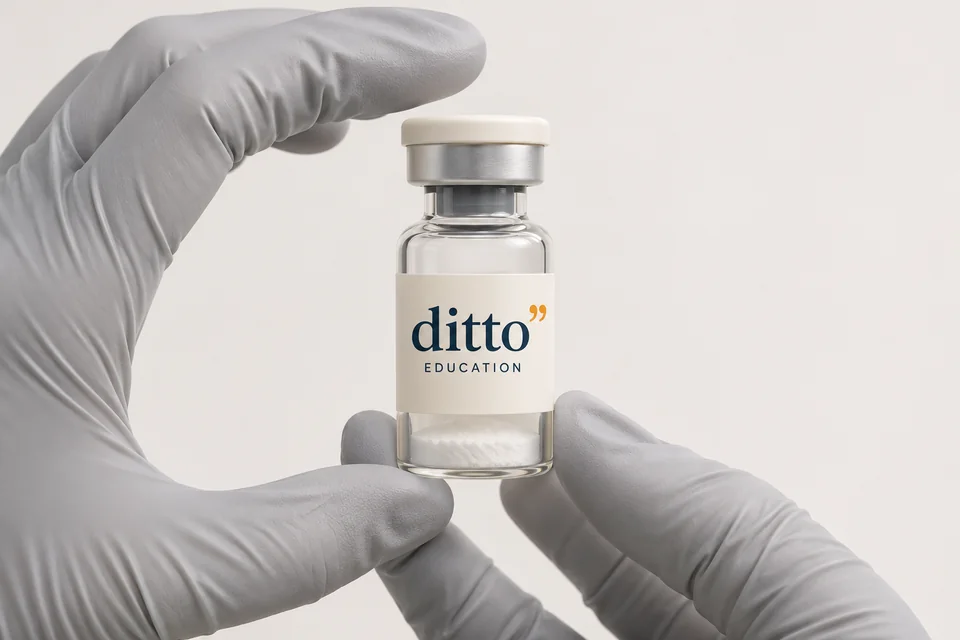
An illustrated reading aid for the product instructions. Confirm the exact formulation, diluent and handling method first. A research-only vial is not an approved medicine.
Check preparation conditions
Check the product instructions for the required preparation temperature. Do not warm a vial or change storage conditions based on a generic peptide guide.

Clean the stopper
If the product instructions call for vial access, disinfect the exposed rubber stopper with a fresh alcohol swab and let it dry. Avoid touching it afterward; use sterile equipment for each access.

Measure the specified diluent
Confirm the diluent type and volume in the product instructions. Measure that volume using the correct syringe scale. A concentration calculation cannot establish that a diluent is compatible.

Add as instructed
Follow the product-specific addition method. Where slow addition along the vial wall is specified, keep the flow gentle. Do not infer a preparation method from a dose table or combine separate compounds in one vial.

Mix and inspect
Use the mixing method specified for the product; some require gentle swirling rather than shaking. Compare the appearance with the instructions. Do not use a preparation with unexpected particles, discoloration or suspected contamination.
Mix and inspect
Use the mixing method specified for the product; some require gentle swirling rather than shaking. Compare the appearance with the instructions. Do not use a preparation with unexpected particles, discoloration or suspected contamination.

Record and store
Record the preparation date and calculated concentration in mg/mL and mcg/mL. Follow the exact storage conditions and discard time on the product instructions. There is no universal refrigerated shelf life for all peptides.
AI-generated educational scenes with Ditto-inspired concept labels; not photographs of supplied products. CDC preparation and equipment principles · Check your calculation
Need custom math?
If your vial size, BAC water volume, or target dose does not match the table, use the University of Peptide calculator for exact syringe units.
Ipamorelin Dosage Chart
This chart matches the single illustrative example in the schedule table. All amounts are daily totals. A divided schedule splits that total rather than multiplying it.
 UNIVERSITY OF PEPTIDE · RESEARCH REFERENCE
Ipamorelin Dosage Chart
| Stage | Window | Daily total | Frequency / amount each time |
|---|---|---|---|
| A | Week 1 | 100 mcg/day (0.1 mg/day) | Once daily: 100 mcg (0.1 mg) |
| B | Weeks 2–3 | 200 mcg/day (0.2 mg/day) | Once daily: 200 mcg (0.2 mg); or twice daily: 100 mcg (0.1 mg) each |
| C | Weeks 4–8 | 200–300 mcg/day (0.2–0.3 mg/day) total | Once daily: 200–300 mcg (0.2–0.3 mg); or twice daily: 100–150 mcg (0.1–0.15 mg) each |
| D | Weeks 9–12 | 200–300 mcg/day (0.2–0.3 mg/day) total | Once daily: 200–300 mcg (0.2–0.3 mg); or twice daily: 100–150 mcg (0.1–0.15 mg) each |
| Off-period example | 4 weeks | No administration | No proven benefit from this break |
How Ipamorelin Works
Ipamorelin activates the GHS-R1a, or ghrelin, receptor and can stimulate pituitary growth-hormone release. GH then signals the liver and other tissues to make IGF-1; the liver does not convert GH into IGF-1.
Raun et al. 1998 characterized selectivity in animal experiments. Those results do not prove that community subcutaneous use has no cortisol, ACTH, or prolactin effects in humans.
The human IV study measured GH responses and an approximately two-hour terminal half-life. Those findings are not proof of improved body composition, recovery, sleep, or anti-aging benefits, and they do not set a subcutaneous frequency.
Who Ipamorelin Is For and Who Should Avoid It
Ipamorelin is a research compound. It is not approved for any human use. Even within research contexts, there are clear groups for whom the risk-benefit math does not work.
Avoid use in
- Active or recent cancer. GH and IGF-1 can support cell growth. Anyone with current or recent cancer should avoid GH-raising compounds.
- Uncontrolled blood sugar disease (type 1 or type 2 diabetes). GH affects insulin sensitivity. Glucose control can shift.
- Severe heart disease. GH can cause fluid retention. That can stress an already weak heart.
- Pregnancy or breastfeeding. There is no safety data for ipamorelin in either group.
- Children or teens. GH and IGF-1 directly affect growth plates. Ipamorelin is not for anyone still growing.
- Competitive athletes. Ipamorelin and all ghrelin mimetics are banned under WADA rules.
Use extra caution if
- A strong family history of cancer.
- Pre-diabetes or fasting glucose near the high end of normal.
- Use of medications that affect blood sugar (insulin, GLP-1s, steroids).
- Sleep apnea, which GH can worsen.
- Carpal tunnel symptoms, which GH-related fluid retention can flare.
Monitoring boundaries
Some practitioners review fasting glucose and HbA1c before and during extended ipamorelin protocols. This page is not medical advice. Any decision to start, continue, or stop a research compound is between an individual and their licensed clinician.
Ipamorelin Side Effects & Safety
Human safety evidence for community subcutaneous use is limited. Animal hormone-selectivity findings and short IV studies do not establish a safe range or prove that adverse effects are mild or brief.
- Reports of headache, fluid retention, tingling, appetite changes, or injection-site reactions do not establish their frequency or long-term risk.
- Changes in GH/IGF-1 can affect glucose-related physiology; a clinician should assess individual risks.
- New, severe, or persistent symptoms need clinical assessment. There is no evidence-based rule here for treating side effects by changing a community dose.
Human IV evidence and FDA concerns
The Beck et al. 2014 postoperative-ileus trial used a monitored IV regimen in surgical patients. Its findings cannot be transferred to long-term subcutaneous use for cosmetic or body-composition goals. FDA notes insufficient safety information for other injectable routes and reports serious events, including deaths, in IV postoperative research. That statement does not establish that ipamorelin caused those deaths.
Product quality
A certificate of analysis reports selected test results; it does not establish that a research vial is sterile, stable after mixing, approved, or safe to inject. See the Evidence library for related context.
Ipamorelin Timeline & What to Monitor
The cited studies do not establish a timeline for body-composition, recovery, sleep, or anti-aging benefits from subcutaneous ipamorelin. IV GH-response timing cannot be relabeled as a subcutaneous response or a benefit timeline.
A clinician may assess symptoms, IGF-1, fasting glucose, and HbA1c when appropriate. Normal monitoring results do not validate an unapproved regimen or exclude long-term harms. Persistent headaches, vision changes, or other new symptoms need clinical review.
Ipamorelin Clinical Evidence Context
Published research separates into animal pharmacology, human IV pharmacokinetics, and postoperative gut-recovery trials. None validates the community subcutaneous schedule on this page.
Studies and limits
| Study | Population / route | What it can support | What it cannot support |
|---|---|---|---|
| Raun et al. 1998 | Animal experiments, including rats and swine | Preclinical GH-secretagogue selectivity | No-hormone-side-effect claim for humans at community doses |
| Gobburu et al. 1999 | Healthy men; five 15-minute IV infusion levels | IV pharmacokinetics and GH responses; terminal half-life about two hours | 300-mcg subcutaneous ceiling, daily frequency, or safe maximum |
| Beck et al. 2014 | Bowel-resection patients; monitored IV trial | Study-specific postoperative-ileus efficacy and adverse-event results | Long-term subcutaneous safety or body-composition benefits |
| NCT01280344 / NCT00672074 | Postoperative gastrointestinal recovery studies | Study design and trial-specific results | A community GH-optimization or anti-aging regimen |
See the Sources & Research links. Route, formulation, population, and outcome must match before findings can be transferred.
The Sigalos and Pastuszak review covers growth-hormone secretagogues broadly and emphasizes gaps in long-term safety evidence. It is not an ipamorelin subcutaneous dose trial.
Ipamorelin Storage & Handling
Storage conditions and expiry must come from validated data for the exact product, formulation, container, and handling conditions.
Ipamorelin storage evidence
| Material | Required information | Limit |
|---|---|---|
| Unmixed powder | Product-specific storage and expiry data | No generic months-to-years shelf life is established here. |
| Reconstituted material | Validated temperature, stability and beyond-use date | No universal 28-day or 2–4-week use period is established. |
| Frozen material | Product-specific freezing and thawing validation | Freezing or aliquoting does not establish a safe extended life. |
| Opened bacteriostatic water | Manufacturer’s post-opening discard instructions | Bottle count depends on time as well as volume. |
No product-specific stability study is cited here. Refrigeration, a clear appearance, or the presence of benzyl alcohol does not establish sterility, potency, or a safe use period. Vial-yield arithmetic cannot determine a discard date.
Ipamorelin Protocol Mistakes & Troubleshooting
Confusing daily total with amount per administration
In the example table, 200–300 mcg/day (0.2–0.3 mg/day) is the entire day’s amount. If divided equally twice daily, the arithmetic is 100–150 mcg (0.1–0.15 mg) each. This clarification is not a dose recommendation.
Cloudiness, particles, or discoloration
Do not use material with unexpected changes. A clear appearance does not establish sterility or potency.
Wrong water volume
Concentration changes with water volume. Recalculate using total mcg divided by total mL and verify the label. The University of Peptide calculator handles custom arithmetic, but cannot determine whether material is suitable to use.
Missed administration or symptoms
No validated missed-dose rule is established here. Seek clinical advice for an existing regimen or persistent symptoms rather than improvising doses.
Storage excursion
A responsible pharmacist or manufacturer needs product-specific stability information to assess an excursion. Neither refrigeration nor freezing establishes an extended use period.
Ipamorelin Regulatory Status
Ipamorelin is not FDA-approved for human use. A compounding nomination, advisory review, or list change is not drug approval or evidence of safety.
The FDA safety-risk page identifies ipamorelin acetate in its 503B Category 2 material and discusses withdrawn 503A nominations. These are different regulatory pathways. FDA describes insufficient information about safety by injectable routes other than the studied IV context. Current pharmacy eligibility requires separate professional review.
Ipamorelin is named in the 2026 WADA Prohibited List, S2.2.4, and is prohibited at all times for athletes subject to those rules.
Ipamorelin vs CJC-1295 vs Tesamorelin vs GHRP-2 vs GHRP-6
Ipamorelin, GHRP-2, and GHRP-6 act through the ghrelin receptor. Preclinical selectivity differences do not prove a safer human community regimen. See the GHRP-6 peptide guide for separate evidence and context.
CJC-1295 No DAC acts at the GHRH receptor. A different receptor is a rationale for investigating combinations, not proof that a stack provides larger useful benefits or is safe. This page does not specify a validated combination dose. See the CJC-1295 + Ipamorelin Dosage Chart & Stack Guide for combination-specific context.
Tesamorelin and sermorelin are GHRH analogs. Their clinical histories cannot establish ipamorelin efficacy or safety. See the tesamorelin + ipamorelin blend protocol for distinct combination context.
Compound-specific guides: Tesamorelin, Sermorelin, CJC-1295 No DAC, and CJC-1295 DAC.
Ipamorelin Blood Tests & Monitoring
Ipamorelin is usually discussed as a GH secretagogue pathway peptide. Monitoring focuses on IGF-1, glucose handling, lipids, thyroid context, appetite, and fluid-retention symptoms.
Blood test markers to discuss with a clinician
| Marker | Why it matters | Timing |
|---|---|---|
| IGF-1 | Shows the downstream signal after repeated GH secretagogue activity. | Follow-up |
| A1c | Tracks longer-term glucose control because GH-axis changes may affect insulin sensitivity. | Baseline |
| Fasting glucose | Gives a current glucose snapshot during GH-axis protocols. | Follow-up |
| Lipid panel | Reviews cholesterol and triglyceride trends during body-composition changes. | Baseline |
| TSH and free T4 | Helps separate thyroid-related symptoms from GH-axis effects. | Optional |
Monitoring guidance is GH-secretagogue pathway-based because ipamorelin-specific clinical monitoring standards are limited.
At-home blood test option
Easy at home option to monitor core metrics during research cycles.
Beyond Whoosh
Pharmacy Grade Tesamorelin / Ipamorelin
Prescription-grade peptide care through Beyond Whoosh. Whoosh prescribes after a clinician reviews your eligibility.
Simple timing framework
- Baseline
- Discuss baseline labs before starting, especially with diabetes risk, sleep apnea, edema, cancer history, or thyroid disease.
- Follow-up
- Re-check IGF-1 and metabolic markers after 6-8 weeks or after meaningful dose changes.
- Longer term
- For longer protocols, review trends every 3-6 months with a clinician.
How to interpret the labs
- IGF-1 trends should be interpreted with age, symptoms, and baseline levels.
- Appetite, water retention, sleep apnea symptoms, and glucose changes are important pathway signals.
- Cancer history or active malignancy concerns need clinician review before GH-axis stimulation is considered.
Do not wait for routine labs
Rapid swelling, severe headaches, vision changes, chest pain, or shortness of breath needs medical review. New numbness, wrist pain, or worsening sleep apnea symptoms should be discussed with a clinician.
FAQ
Q1: What is ipamorelin?
Ipamorelin, also called NNC 26-0161, is a ghrelin-receptor agonist that can stimulate growth-hormone release. Preclinical selectivity does not establish the absence of other hormone effects in humans at community doses. It is not FDA-approved.
Q2: What is the starting dose of ipamorelin?
There is no validated subcutaneous starting dose established here. The illustrative community table uses 100 mcg (0.1 mg) once daily in week 1, then 200 mcg/day (0.2 mg/day) total in weeks 2–3. It is not a treatment recommendation or safe range.
Q3: What is the typical ipamorelin dosage per day?
No approved daily subcutaneous regimen is established. The illustrative table shows 100 mcg/day (0.1 mg/day) in week 1, 200 mcg/day (0.001, 0.2 mg/day) in weeks 2–3, and 200–300 mcg/day (0.2–0.3 mg/day) total in weeks 4–12. These examples are not clinically validated.
Q4: What is the ipamorelin dosage chart by vial size?
For a 2 mg (2,000 mcg) vial with 1.0 mL BAC water: 200 mcg (0.2 mg) = 10 units. For a 5 mg (5,000 mcg) vial with 2.0 mL BAC water: 200 mcg (0.2 mg) = 8 units. For a 10 mg (10,000 mcg) vial with 3.0 mL BAC water: 200 mcg (0.2 mg) = 6 units. Units are based on a standard U-100 insulin syringe. See the full reconstitution table on this page.
Q5: How many mL of ipamorelin should be used?
There is no fixed mL amount. The volume depends on the vial strength and how much bacteriostatic water was added. Convert the target mcg amount using the concentration created during reconstitution.
Q6: How many units of ipamorelin are in a U-100 syringe?
The number of syringe units depends on the concentration after reconstitution. A U-100 syringe contains 100 units per 1 mL, so 1 unit equals 0.01 mL. Use the page calculator or reconstitution table to convert mcg into volume.
Q7: Is a 10 mg (10,000 mcg) vial an ipamorelin dose?
No. A 10 mg (10,000 mcg) vial contains 10 mg (10,000 mcg) total, or 10,000 mcg (10 mg). The vial size is not the amount used in one administration.
Q8: How is ipamorelin reconstituted?
The arithmetic examples use 2 mg (2,000 mcg) / 1 mL, 5 mg (5,000 mcg) / 2 mL, or 10 mg (10,000 mcg) / 3 mL. They do not establish that a product is suitable for injection. Follow validated product-specific preparation, storage, and discard instructions; a universal 28-day life is not established.
Q9: What is ipamorelin's half-life?
Gobburu et al. 1999 measured an approximately two-hour terminal half-life after 15-minute IV infusions in healthy men. This does not establish subcutaneous dose timing, frequency, or a safe maximum.
Q10: Is ipamorelin FDA-approved?
No. FDA identifies safety uncertainties for injectable ipamorelin. Compounding nominations and advisory reviews do not equal approval or proof of safety. Ipamorelin is also named in WADA S2.2.4 and prohibited at all times for athletes subject to those rules.
Q11: Is ipamorelin dosed differently for women and men?
Published research has not established separate standard subcutaneous doses for men and women. Community schedules should not be treated as clinically proven sex-specific dosing.
Q12: What is the ipamorelin dosing schedule for beginners?
No clinically validated beginner schedule is established. The illustrative table uses 100 mcg/day (0.1 mg/day) in week 1, 200 mcg/day (0.001, 0.2 mg/day) in weeks 2–3, and 200–300 mcg/day (0.2–0.3 mg/day) total in weeks 4–12. From week 2 the total may be shown once daily or divided equally twice daily; 300 mcg/day (0.3 mg/day) divided twice means 150 mcg (0.15 mg) each. The four-week break is also unvalidated.
Q13: How often is ipamorelin used in research protocols?
The example table uses once daily in week 1, then once daily or a divided total in two administrations. Human IV research does not establish a standard subcutaneous frequency. The daily total must not be multiplied by the number of administrations.
Q14: How is the CJC-1295 + ipamorelin stack dosed?
No clinically validated combination dose is established by the sources on this page. Different receptor pathways do not prove a stack is effective or safe. See the CJC-1295 + Ipamorelin stack guide for separate combination context.
Q15: How long is a typical ipamorelin cycle?
This page’s illustrative example spans 12 weeks followed by a four-week break. No trial validates that cycle or shows that the break preserves receptor responsiveness. It is not a recommendation.
Q16: What is the maximum daily dose of ipamorelin?
No safe or effective maximum for community subcutaneous use is established. The cited human IV study does not prove a 300-mcg-per-shot saturation ceiling or validate 600- or 900-mcg daily schedules. The table’s 200–300 mcg/day (0.2–0.3 mg/day) is an unvalidated example, not a maximum.
Q17: What are the most common ipamorelin side effects?
Reported effects include headache, fluid retention, tingling, and local reactions, but their frequency in community subcutaneous use is not established. Animal hormone-selectivity data do not prove that human cortisol or prolactin remain unchanged, or that side effects are mild or brief.
Q18: How does ipamorelin compare to CJC-1295?
Ipamorelin acts at the ghrelin receptor, while CJC-1295 acts at the GHRH receptor. This mechanistic difference does not prove a combination’s benefit or safety. Long-acting CJC-1295 with DAC is also distinct from No DAC.
Q19: How should reconstituted ipamorelin be stored?
Storage and discard must follow validated instructions for the exact product. This page establishes no universal 28-day refrigerated life or months-long frozen life. Bacteriostatic water and clear appearance do not establish stability or sterility.
Q20: Where can I calculate exact syringe units?
Use the University of Peptide calculator to convert vial size, BAC water volume, and target dose into exact syringe units.
Sources & Research
- Raun K, Hansen BS, Johansen NL, et al. Ipamorelin, the first selective growth hormone secretagogue. European Journal of Endocrinology (1998)
- Gobburu JV, Agerso H, Jusko WJ, Ynddal L. Pharmacokinetic-pharmacodynamic modeling of ipamorelin, a growth hormone releasing peptide, in human volunteers. Pharmaceutical Research (1999)
- Beck DE, Sweeney WB, McCarter MD; Ipamorelin 201 Study Group. Prospective, randomized, controlled, proof-of-concept study of the Ghrelin mimetic ipamorelin for the management of postoperative ileus in bowel resection patients. International Journal of Colorectal Disease (2014)
- Ishida J, Saitoh M, Ebner N, et al. Growth hormone secretagogues: history, mechanism of action, and clinical development. JCSM Rapid Communications (2020)
- ClinicalTrials.gov Safety and Efficacy of Ipamorelin Compared to Placebo for the Recovery of Gastrointestinal Function (NCT01280344). ClinicalTrials.gov (2011)
- ClinicalTrials.gov Ipamorelin in Postoperative Ileus (NCT00672074). ClinicalTrials.gov (2008)
- U.S. Food and Drug Administration Certain Bulk Drug Substances for Use in Compounding that May Present Significant Safety Risks (ipamorelin acetate). FDA.gov (2026)
- U.S. Food and Drug Administration FDA Summary Report: Ipamorelin Acetate (PCAC review materials). FDA.gov / Regulations.gov (2024)
- Buscail E, Deraison C. Postoperative ileus: A pharmacological perspective. British Journal of Pharmacology (2022)
- Sigalos JT, Pastuszak AW. The Safety and Efficacy of Growth Hormone Secretagogues (review; not an ipamorelin subcutaneous dose trial). Sexual Medicine Reviews (2018)
- World Anti-Doping Agency Prohibited List — S2 Peptide Hormones, Growth Factors, Related Substances and Mimetics (covers ghrelin mimetics). WADA (2026)
Related Dosing Protocols
Educational use only
This guide is an educational research reference, not medical advice or a treatment plan. Ipamorelin is not FDA-approved for any human use.
Calculate ipamorelin vial math
Use the calculator for custom vial size, BAC water volume, and syringe-unit math.
Reconstitution calculator
Enter your own values. This tool calculates quantities, not a recommended dose.
Check the concentration
Changing the unit keeps the entered mass equivalent. 1 milligram (mg) = 1,000 micrograms (mcg). This tool does not choose a target amount.
Biological IU (optional, product-specific)
Only enter a potency explicitly stated as IU per mg on the exact product label or reference. Do not enter the 100 from a U-100 syringe. No factor is assumed for any peptide.
Your result will appear here
Enter the mass, final solution volume and target mass, or load a fictional example.
Assumes accurate masses, final solution volume and even distribution. Blend arithmetic does not establish whether substances can be mixed. Read the formulas and assumptions.
Study findings, reported examples and supplier statements have different levels of evidence. Follow the citations and check the formulation, population and date before interpreting a number.
Editorial standards and corrections