On this page
TOOLS FOR THIS GUIDE
Work with Lipo-C
The guide name carries across. Amounts, dates and instructions remain yours to enter; opening a tool saves nothing.
Worked examples: calculations, records and source checks
Fictional arithmetic, unrelated to a recommended amount of Lipo-C: 10 mg (10,000 mcg) in a final 2 mL is 5 mg/mL (5,000 mcg/mL). A target mass of 0.25 mg (250 mcg) corresponds to 0.05 mL, or 5 U-100 syringe markings. Biological IU cannot be inferred from these inputs. Neither the mass nor the liquid is a preparation recommendation.
Open the arithmetic example- Supply example: two 10 mg (10,000 mcg) vials start at 20 mg (20,000 mcg). Four recorded entries of 0.25 mg (250 mcg) leave a theoretical 19 mg (19,000 mcg), before losses or expiry. Skipped entries do not deduct stock.
- Measurement example: enter “Sleep duration”, “7.5”, “hours” and the date. Keep the same unit and note changing conditions. A trend does not prove a treatment effect.
- Source example: record “rat study” when rats were studied, even when the headline describes recovery. Keep the exact paper and its limitations.
The planner accepts mg and mcg. Biological IU/USP units, sprays, drops and variable mixtures need product-specific instructions; they cannot be inferred from a generic mass calculator. For stacks, record each known ingredient separately.
FDA: why concentration and unit errors matterEvidence & source checks
Check the identity: Variable compounded mixture. The source describes common ingredients, not a verified composition for every product. Ingredient-level overlap remains unresolved.
Lipo-C: source check
The cited review analyzed L-carnitine supplementation, not a standardized Lipo-C injectable mixture.
Limit: Evidence for one ingredient does not validate a variable multi-ingredient product. The full composition must be established first.
Question to resolve: What ingredients and quantities are actually on this batch’s label?
Source and reading scope
Effects of l-carnitine supplementation on weight loss and body composition: A systematic review and meta-analysis of 37 randomized controlled clinical trials with dose-response analysis.
PubMed abstract; not an independent clinical review. Checked 25 November 2026.
What to verify before filling a plan
- Identity and formulation: match the name, sequence or active ingredient, route and strength. A related molecule or branded medicine is not automatically equivalent.
- Instruction source: obtain the actual amount, frequency and duration from qualified medical instructions. A community table or trial protocol does not establish an individual regimen.
- Units and product details: keep mass, liquid volume and biological activity units separate. Record batch, storage and discard instructions from the actual product; the tools cannot determine sterility or stability.
- Review and follow-up: list medicines and supplements, unresolved interactions and questions. Agree on relevant observations and actions with a qualified professional; normal measurements do not prove safety.
Selected source context, not a systematic review or medical approval. Study cards checked 24 November 2026; guide source notes checked 25 November 2026. Research references and citations appear below.
Guide summary
REFERENCE SUMMARY- Compound
- Lipo-C (lipotropic injection blend)
- Class
- Compounded amino-acid + B-vitamin lipotropic (not a peptide)
- Common format
- Pre-mixed multi-dose vial; SubQ or IM
- Regulatory status
- Not FDA-approved (compounded)
Lipo-C Overview
Lipo-C is a compounded lipotropic injection. It is a blend of amino acids and vitamin-like nutrients that a compounding pharmacy mixes together, usually for weight-management programs. A very common formula pairs methionine, inositol, choline (the "MIC" core), and L-carnitine with vitamin B1 (thiamine) and vitamin B5 (dexpanthenol). Some clinics add vitamin B12.
Even though it is often searched as "lipo c peptide," Lipo-C is not a peptide. Methionine and carnitine are amino acids, choline and inositol are vitamin-like nutrients, and the B-vitamins are vitamins. None of them form a peptide chain. This matters because a lot of online storage advice claims Lipo-C "denatures" like a peptide, which is not how these ingredients actually behave.
"Lipotropic" means a substance that helps the body move or process fat, mostly in the liver. Clinics market Lipo-C as a fat-metabolism and energy support shot. The honest framing: it is a low-risk adjunct layered on top of the things that actually drive results — a calorie deficit, food quality, and physical activity.
Educational use only
This page is an educational research and dosing-context reference, not medical advice or a treatment plan. Lipo-C is a compounded product that is not FDA-approved. Talk to a qualified clinician before starting any injection.
Lipo-C Dosing Context & Schedule
Lipo-C has no standardized, FDA-approved dose. Because it is compounded, the exact strengths and schedule vary by pharmacy and prescriber. The numbers below describe commonly reported compounded practice, not a recommendation. A clinician sets any actual plan.
Compounding-pharmacy references commonly describe Lipo-C as a 1 mL injection given once or twice weekly, by subcutaneous (SubQ) or intramuscular (IM) route. Research-market guides sometimes describe 0.5–1.0 mL two to three times weekly. The ingredient strengths are printed on the vial as mg/mL, so the total nutrients per shot depend on that specific formula.
Reported compounded Lipo-C administration context (not medical advice)
| Item | Commonly reported context |
|---|---|
| Route | Subcutaneous or intramuscular |
| Volume per injection | About 0.5–1 mL, per the compounded label |
| Frequency | Once or twice weekly (some plans 2–3x weekly) |
| Example formula strength | Methionine/Inositol/Choline/L-Carnitine/B1/B5 at 15/50/50/50/15/5 mg/mL (Empower-style) |
| Cycle framing | Used as an ongoing adjunct alongside diet and exercise |
Strengths and schedule vary by pharmacy. Always follow the exact compounded label and prescriber instructions.
Evidence boundary
No controlled trial has tested this combination at any dose for weight loss. Any weight change reported by users is driven mainly by the diet and exercise plan the shot is paired with, not by the injection itself.
Lipo-C Supplies
Most compounded Lipo-C arrives as a ready-to-use refrigerated solution, so the supply list is simple: the vial, syringes, and swabs. BAC water is only relevant for lyophilized research-market vials that ship as powder. This is a planning checklist, not dose math or medical advice.
Recommended Supply
Choose your region
Use discount code SAVE10 at Peptira checkout. See why we love Peptira.
Lipo-C

At-Home Blood Test
Research Supplies
Lipo-C Vials (pre-mixed)
Volume-only counts for 1 mL twice weekly. The label's beyond-use date may require more vials; these totals do not establish usable life.
| Plan length | Planning note |
|---|---|
5 weeks 1 x 10 mL vial | 10 doses at 1 mL each |
10 weeks 2 x 10 mL vials | 20 doses at 1 mL each |
15 weeks 1 x 30 mL vial | 30 doses at 1 mL each |
Insulin Syringes (U-100)
One syringe per injection. Prefer 1 mL / 100-unit syringes for a 1 mL draw.
| Plan length | Planning note |
|---|---|
5 weeks 10 syringes | 2 per week |
10 weeks 20 syringes | 2 per week |
Round up for priming losses, dropped syringes, and site rotation. If your vial is lyophilized powder, add BAC water and follow the reconstitution tab.
Companion Supplies & Routine Support
Lipo-C + B12 Dosage Chart
This Lipo-C + B12 dosage chart summarizes the ready-to-use, pre-mixed administration context from the dosing section: common volume, frequency, route, and formula-strength notes.
 UNIVERSITY OF PEPTIDE · RESEARCH REFERENCE
Lipo-C + B12 Dosage Chart
Lipo-C + B12 dosage chart showing ready-to-use pre-mixed administration context.
Lipo-C Format & Reconstitution
Do you need to mix your Lipo-C?
Choose the format you received. Most pharmacy Lipo-C is already mixed.
Open a format reference below.
Pre mixed format reference
Ready-to-use pharmacy solution.
Compounded Lipo-C from pharmacies like Empower, Defy, or Medivera is dispensed as a ready-to-use liquid. There is nothing to reconstitute. The strengths are already fixed at mg/mL on the label, and the vial is kept refrigerated. You simply draw the labeled volume into a syringe.
At a common strength, 1 mL = the full labeled mg of each ingredient, and on a U-100 syringe 50 units = 0.5 mL, 100 units = 1 mL. This is measurement math only, not a dose recommendation.
Lyophilized format reference
Powder that must be mixed with BAC water.
Some research-market vials arrive as a freeze-dried powder that must be mixed with bacteriostatic water before use. Bacteriostatic water (not plain sterile water) contains a preservative that allows multi-dose storage.
An illustrated reading aid for the product instructions. Confirm the exact formulation, diluent and handling method first. A research-only vial is not an approved medicine.

Check preparation conditions
Check the product instructions for the required preparation temperature. Do not warm a vial or change storage conditions based on a generic peptide guide.
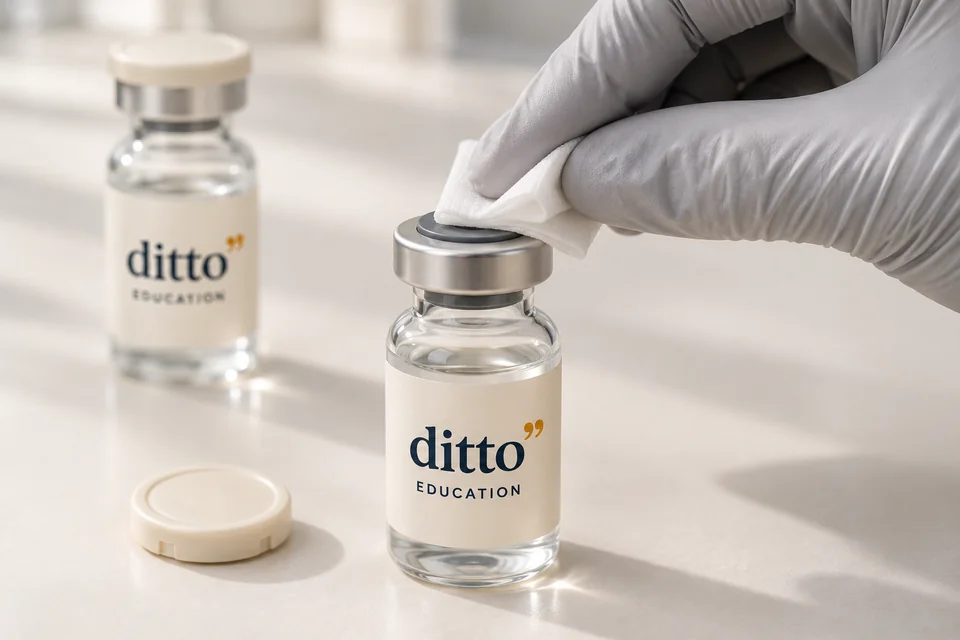
Clean the stopper
If the product instructions call for vial access, disinfect the exposed rubber stopper with a fresh alcohol swab and let it dry. Avoid touching it afterward; use sterile equipment for each access.

Add as instructed
Follow the product-specific addition method. Where slow addition along the vial wall is specified, keep the flow gentle. Do not infer a preparation method from a dose table or combine separate compounds in one vial.
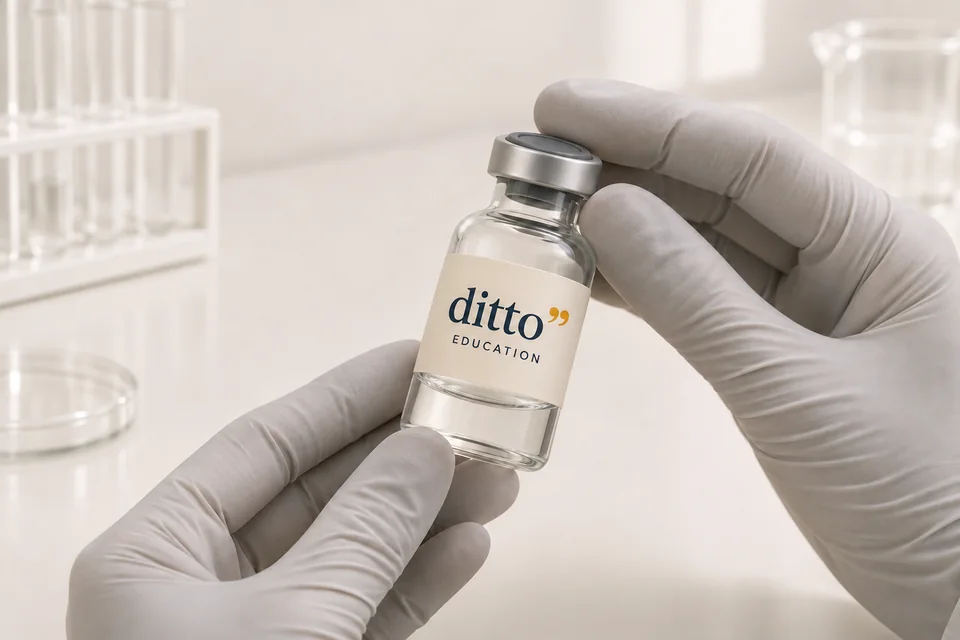
Mix and inspect
Use the mixing method specified for the product; some require gentle swirling rather than shaking. Compare the appearance with the instructions. Do not use a preparation with unexpected particles, discoloration or suspected contamination.
Check the exact product
Read the label, formulation, vial content, expiry and preparation instructions. Check the vial and closure for damage. Appearance alone cannot establish identity, purity or sterility.
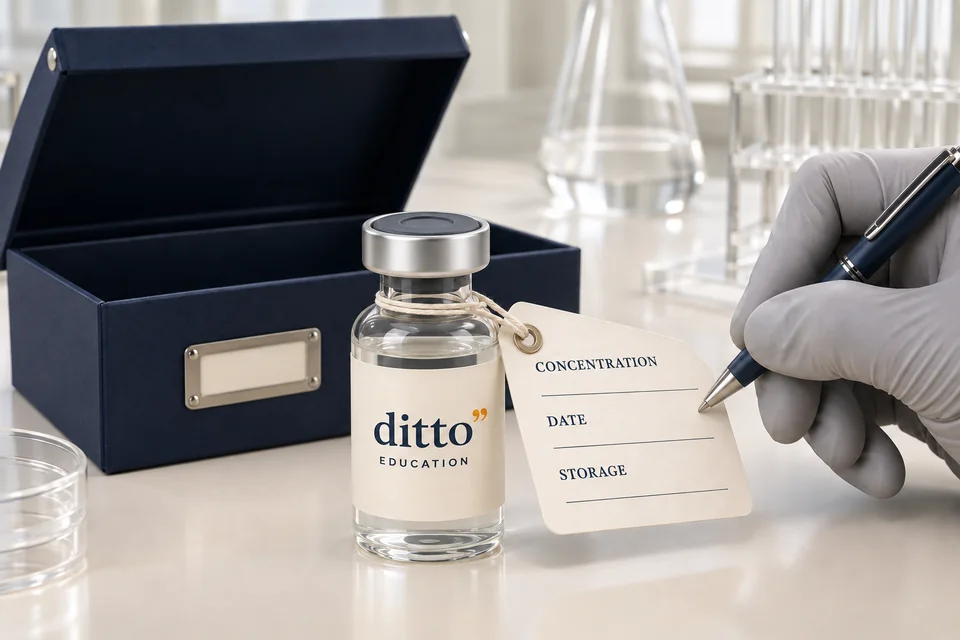
Record and store
Record the preparation date and calculated concentration in mg/mL and mcg/mL. Follow the exact storage conditions and discard time on the product instructions. There is no universal refrigerated shelf life for all peptides.
Record and store
Record the preparation date and calculated concentration in mg/mL and mcg/mL. Follow the exact storage conditions and discard time on the product instructions. There is no universal refrigerated shelf life for all peptides.
AI-generated educational scenes with Ditto-inspired concept labels; not photographs of supplied products. CDC preparation and equipment principles · Check your calculation
Use the calculator for custom vials
If your powder vial lists a total mg amount, use the calculator to convert vial size, BAC water volume, and target amount into mL and U-100 syringe units.
How Lipo-C Is Supposed to Work
The plain-English idea: each ingredient plays a small role in how the body handles fat and energy, so clinics combine them into one shot. The biology of each nutrient is real. What is missing is proof that injecting them speeds up fat loss in people who already eat enough of these nutrients.
- Methionine
- An amino acid that donates methyl groups, helping the liver package and export fat.
- Choline
- Helps the liver move fat out and supports cell membranes; deficiency can cause fatty liver.
- Inositol
- A vitamin-like sugar tied to insulin signaling; studied mostly in PCOS and insulin resistance.
- L-carnitine
- Shuttles long-chain fats into mitochondria so they can be burned for energy.
- B1 / B5 (± B12)
- Support the enzymes and coenzyme A that keep fat and energy metabolism running.
Here is the key caveat: most of this mechanism is extrapolated from individual ingredients, often studied as oral supplements and sometimes only in animals or specific patient groups. There is no direct evidence that the combined injection meaningfully increases fat loss on its own.
Who Should Be Cautious
- Anyone who is pregnant or breastfeeding, unless a clinician specifically approves it.
- People with a known allergy or sensitivity to any ingredient, or to preservatives like benzyl alcohol in the diluent.
- People with liver or kidney conditions, who should have a clinician review the plan first.
- Anyone taking other medications, since a prescriber should check for interactions before adding a compounded injection.
Talk to a qualified clinician
This is general information, not a screening tool. A licensed prescriber should review your history, medications, and labs before you use any compounded injection.
Lipo-C Side Effects
Reported side effects are usually mild, and the most common is injection-site reaction — soreness, redness, warmth, or a small lump. This is expected with frequent shots and improves with site rotation.
Why does Lipo-C burn? A brief sting for 10–15 minutes after the shot is common. It comes from tissue stretching as the fluid goes in and from the pH difference between the solution and body tissue. Burning or pain that lasts well beyond that, or swelling that grows over hours, can mean the shot went too deep (IM instead of SubQ) or a reaction to the preservative — reasons to check technique and talk to your provider.
- Injection-site soreness, redness, warmth, or lumps (most common).
- Short-lived stinging or burning right after injection.
- Nausea, GI upset, or a temporary fishy body odor at high choline exposure.
- Rarely, allergic reactions — stop and seek care for rash, swelling, or trouble breathing.
A note on choline
Very high choline intake can raise TMAO, a marker linked to cardiovascular risk in observational studies. A causal link is not established, but it is a reason to keep a clinician involved rather than self-escalating.
What to Expect
Many users report a short-term energy or mood lift, especially if a B12 or B-vitamin component corrects a real deficiency. That is separate from fat loss.
For weight and body composition, honest expectation-setting matters: the injection does not create weight loss on its own. Any "before and after" results people share come from the overall program — the calorie deficit, food quality, activity, and often GLP-1 medications used alongside it. If diet and exercise do not change, the shot alone is not expected to move the scale.
If a clinician is tracking anything objective, the more relevant markers are things like liver enzymes or metabolic labs over weeks to months, not day-to-day scale changes.
What the Evidence Actually Shows
Direct evidence for Lipo-C is essentially absent. No published randomized controlled trial has tested the methionine-inositol-choline-carnitine-B-vitamin combination as an injection for weight loss. Everything below is ingredient-level evidence, mostly from oral supplements.
L-carnitine — modest, shrinking effect
A 2016 meta-analysis of 9 RCTs (n=911) found carnitine users lost about 1.33 kg more than controls, and a larger 2020 meta-analysis of 37 RCTs (n=2,292) found roughly 1.21 kg. Both note the effect is small and fades over time.
Inositol — metabolic signals, mainly in PCOS
Myo-inositol can improve insulin sensitivity and some metabolic markers in PCOS, but a 2023–2024 systematic review for the international PCOS guidelines called the evidence limited and inconclusive, and weight/waist measures often did not improve.
Choline & methionine — hepatic roles, not weight-loss proof
Both support the liver's ability to export fat, and deficiency can cause fatty liver. But major guidance does not recommend supplementing them to treat fatty liver or to drive weight loss in people who already get enough.
B12 injections — no weight-loss edge
Studies comparing injected vs oral B12 during calorie-restricted diets found no difference in objective weight or body-composition outcomes, though the injection group sometimes reported more subjective energy.
Bottom line: individual ingredients have real biochemistry and, for carnitine, a small measurable effect. That does not add up to proof that the injected blend produces meaningful fat loss beyond diet and exercise.
Lipo-C Storage & Handling
Does Lipo-C need to be refrigerated? Yes. Compounded Lipo-C is kept in the refrigerator, and pharmacies typically list a beyond-use date around 30 days from dispensing. Follow the exact date on your label.
Lipo-C storage
| State | Storage |
|---|---|
| Pre-mixed pharmacy solution | 36–46°F (2–8°C) refrigerated; use by the label's beyond-use date (~30 days) |
| Lyophilized powder (unmixed) | Cold storage per supplier; stable much longer while dry |
| After mixing (lyophilized vials) | 36–46°F (2–8°C); protect from heat and light |
| Appearance | Should stay clear; discard if cloudy or discolored |
Keep vials out of heat. The real degradation issue is methionine oxidation over time, not 'denaturation' — Lipo-C has no peptide structure to denature.
Common Lipo-C Questions & Mistakes
- "It stopped working." More often this is expectation mismatch — the injection was never the main driver of weight change. Reassess the diet and activity plan with a clinician.
- Cloudy solution. A clear solution that turns cloudy or discolored should be discarded. Do not inject it.
- Persistent site pain. Rotate sites, confirm SubQ vs IM depth, and ask your provider about preservative sensitivity if pain repeats across sites.
- Left out of the fridge. Prolonged room-temperature storage degrades the amino acids even when the liquid still looks normal; when in doubt, check with the dispensing pharmacy.
Lipo-C Regulatory Status
As of July 2026, Lipo-C is not FDA-approved. There is no FDA-approved fixed-dose Lipo-C product and no approved weight-loss indication for the combination. It is a compounded preparation, made by a pharmacy from bulk ingredients based on a prescriber's order.
The individual ingredients are legal nutrients, but "compounded" means the specific formula is not reviewed by the FDA for safety, effectiveness, or quality the way an approved drug is. That is why formula strengths differ between pharmacies and why insurance usually does not cover it. Quality depends heavily on the compounding pharmacy and the supervising clinician.
Lipo-C vs Lipo-B, MIC & GLP-1 Medications
Lipo-B vs Lipo-C: both are lipotropic shots. "Lipo-B" formulas lean more on B-vitamins, while Lipo-C typically adds L-carnitine and sometimes vitamin C-style branding. Exact contents vary by pharmacy, so read the label rather than the name.
How Lipo-C compares
| Option | What it is | Evidence for weight loss |
|---|---|---|
| Lipo-C | Amino-acid + B-vitamin lipotropic injection | Weak; no combination trials |
| Basic MIC | Methionine, inositol, choline only | Weak; ingredient-level only |
| Lipo-B / B12 shots | B-vitamin-forward lipotropic | Helps energy if deficient; not a weight-loss driver |
| GLP-1 (semaglutide, tirzepatide) | FDA-approved weight-management drugs | Strong RCT evidence (SURMOUNT, STEP) |
Lipo-C sits at the low-evidence end. GLP-1 medications sit at the opposite, well-studied end. They are not interchangeable, and no trial has tested Lipo-C added to a GLP-1.
FAQ
Q1: What is Lipo-C?
Lipo-C is a compounded lipotropic injection used mainly in weight-management programs. A common formula blends methionine, inositol, choline, and L-carnitine with B-vitamins like B1 and B5, and sometimes B12. It is marketed as fat-metabolism and energy support alongside diet and exercise.
Q2: Is Lipo-C a peptide?
No. It is often searched as 'lipo c peptide,' but it does not contain peptides. Its ingredients are amino acids (methionine, carnitine), vitamin-like nutrients (choline, inositol), and vitamins (B1, B5, sometimes B12). There is no peptide chain, so claims that it 'denatures like a peptide' are inaccurate.
Q3: What is in Lipo-C?
A widely used formula is methionine, inositol, choline chloride, L-carnitine, thiamine (B1), and dexpanthenol (B5), often around 15/50/50/50/15/5 mg/mL. Some clinics add vitamin B12. Exact contents vary by compounding pharmacy, so check the label.
Q4: Does Lipo-C actually work for weight loss?
The injection itself is not proven to drive weight loss. No controlled trial has tested the combination, and the strongest ingredient evidence (L-carnitine) shows only about 1–1.3 kg average difference. Any real-world results come mostly from the diet, exercise, and other medications it is paired with.
Q5: How is Lipo-C commonly dosed?
There is no standardized dose because it is compounded. Pharmacy references commonly describe about 1 mL once or twice weekly, given subcutaneously or intramuscularly. This is reported context, not a recommendation. Follow your compounded label and prescriber.
Q6: Does Lipo-C need to be refrigerated?
Yes. Compounded Lipo-C is stored in the refrigerator at about 36–46°F (2–8°C), and pharmacies usually list a beyond-use date around 30 days from when you receive it. Keep it out of heat and light, and discard it if the liquid turns cloudy.
Q7: Why does Lipo-C burn when injected?
A short sting for 10–15 minutes is common and comes from tissue stretching and the pH difference between the solution and your tissue. Burning or swelling that lasts much longer can mean the shot went too deep or a reaction to the preservative, which is worth reviewing with your provider.
Q8: What is the difference between Lipo-B and Lipo-C?
Both are lipotropic shots. Lipo-B formulas usually emphasize B-vitamins, while Lipo-C typically adds L-carnitine and other lipotropic nutrients. Because the recipes vary by pharmacy, the label matters more than the name.
Q9: Is Lipo-C FDA-approved?
No. As of July 2026 there is no FDA-approved Lipo-C product and no approved weight-loss indication for the combination. It is a compounded preparation, so its formula is not FDA-reviewed for safety, effectiveness, or quality the way an approved drug is.
Q10: Is this page medical advice?
No. This is an educational research and dosing-context reference. It does not diagnose, treat, or recommend a dose. Talk to a qualified clinician before using any compounded injection.
Sources & Research
- Empower Pharmacy Lipo-C Injection (formulation, mechanism, compounded status). Empower Pharmacy (2026)
- MediVera Compounding Pharmacy Lipo-C Injection (ingredients, storage, beyond-use date, administration context). MediVera Rx (2026)
- Defy Medical What is in Lipo-C? Defy Medical (2026)
- Pooyandjoo M, Nouhi M, Shab-Bidar S, et al. The effect of (L-)carnitine on weight loss in adults: a systematic review and meta-analysis of randomized controlled trials. Obesity Reviews (2016)
- Talenezhad N, Mohammadi M, Ramezani-Jolfaie N, et al. Effects of L-carnitine supplementation on weight loss and body composition: a systematic review and meta-analysis of 37 RCTs. Clinical Nutrition ESPEN (PubMed) (2020)
- Greff D, Juhász AE, Váncsa S, et al. Inositol for polycystic ovary syndrome: a systematic review and meta-analysis for the 2023 international PCOS guidelines. Journal of Clinical Endocrinology & Metabolism (2024)
- Minozzi M, D'Andrea G, Unfer V, et al. A potential therapeutic role of myo-inositol in the metabolic and cardiovascular profile of PCOS women. PMC (NCBI) (2016)
- Fella Health Lipo C and Tirzepatide: Safety and Clinical Evidence Review (unapproved compounded status; no combination trials). Fella Health (2026)
- GLPbase Lipo C (Lipotropic Injections): The Complete Guide (FDA status, evidence boundary). GLPbase (2026)
- Empire Medical Training MIC & Lipotropic Injections for Weight Loss: A Clinical Guide (adjunct positioning, evidence note). Empire Medical Training (2026)
- Bolt Pharmacy Choline, Inositol & Fatty Liver: Evidence, Dosage and Guidance (choline UL, TMAO association, NICE guidance). Bolt Pharmacy (2026)
Related Dosing Protocols
Educational use only
This guide is an educational research and dosing-context reference, not medical advice or a treatment plan. Lipo-C is a compounded product that is not FDA-approved. Talk to a qualified clinician before using any injection.
Calculate vial math
For lyophilized research vials, use the calculator to convert vial size, BAC-water volume, and target amount into mL and syringe units.
Reconstitution calculator
Enter your own values. This tool calculates quantities, not a recommended dose.
Check the concentration
Changing the unit keeps the entered mass equivalent. 1 milligram (mg) = 1,000 micrograms (mcg). This tool does not choose a target amount.
Biological IU (optional, product-specific)
Only enter a potency explicitly stated as IU per mg on the exact product label or reference. Do not enter the 100 from a U-100 syringe. No factor is assumed for any peptide.
Your result will appear here
Enter the mass, final solution volume and target mass, or load a fictional example.
Assumes accurate masses, final solution volume and even distribution. Blend arithmetic does not establish whether substances can be mixed. Read the formulas and assumptions.
Study findings, reported examples and supplier statements have different levels of evidence. Follow the citations and check the formulation, population and date before interpreting a number.
Editorial standards and corrections